Must-Reads and Some Notes on Taking Action and Staying Whole in 2026
As we close out a year of crisis and courage, I’m thinking about what sustains us — and what comes next.

Greetings friends,
In this edition of the newsletter, I’m sharing some must-reads, organizing resources, closing reflections for the year, and a writing exercise that may help you steady yourself and take stock as we move into 2026.
Must-Reads
Here are some of the most important articles I’ve read lately.
- CNN Partners with Kalshi, a Gambling App that Lets You Wager on Starvation in Gaza by Adam Johnson. “The partnership will include prediction market content related to politics, news, culture and weather.”
- As California Limits Water Use, People in Prison Face Punishment for Showering by Steve Brooks & Olivia Heffernan. “Conservation is necessary, but placing the burden on dangerous and disease-ridden overcrowded prisons is cruel and unfeasible.”
- What OpenAI Did When ChatGPT Users Lost Touch With Reality by Kashmir Hill and Jennifer Valentino-DeVries. “It sounds like science fiction: A company turns a dial on a product used by hundreds of millions of people and inadvertently destabilizes some of their minds. But that is essentially what happened at OpenAI this year.”
- Part 1: My Life Is a Lie: How a Broken Benchmark Quietly Broke America by Michael W. Green. “If one parent stays home, the income drops to $40,000 or $50,000—well below what’s needed to survive. If both parents work to hit $100,000, they hand over $32,000 to a daycare center.”
- ChatGPT May Help You Find Information Faster, But You Learn Less by Bob McDonald. “Chatbots such as ChatGPT can provide direct answers to your questions that seem complete and comprehensive. But a new study shows that, compared to a regular Google search, the amount of knowledge gained is less.”
- Trump’s Illegal Boat Strikes Recall Duterte’s “Drug War” Mass Killings by Marjorie Cohn. “Like Duterte, Trump’s bombing campaign should be considered a crime against humanity.”
- Israel Is Quietly Expanding Its Occupation of Gaza Under Cover of “Ceasefire” by Dalia Abu Ramadan. “What the world does not see is that, day after day, the Israeli military expands its control inside Gaza. It advances slowly, swallowing a street, a neighborhood, an entire area — quietly redrawing the map while the world celebrates a fabricated calm.”
- Suspect in National Guard Shooting Brought the CIA’s Shadow War Home by Emran Feroz. “If U.S. policy makers want to understand how a man trained and empowered by their own security apparatus ended up killing two American soldiers near the White House, they should start with a basic admission: When you run a shadow war for two decades, eventually it stops staying in the shadows.”
- Extralibrary Loan by Shannon Mattern. “I don’t think it’s much of an exaggeration to say that societies are defined by their libraries — by what we hold, what we lend, what we borrow and return, the knowledge we create, the values we defend.”
- The Hard-Left Shooters Leading a Gun Culture Revolution by Manisha Krishnan. “When I check in on Tacticool Girlfriend, she compares this moment to Italy’s Years of Lead, a period of left- and right-wing terrorism from the late 1960s to the 1980s, in which hundreds of people were killed in over 14,000 attacks. If America is going to have another civil war, she predicts, it’ll be closer to that than anything else.”
- ‘We Are Looking at a Massive Crisis’ by Toluse Olorunnipa. “Premiums for the 22 million affected Americans would increase by 114 percent on average … As a result, the Congressional Budget Office projects, the population of uninsured people would rise by more than 2 million next year, and the number would increase to 3.7 million the following year.”
ICYMI
This week, I wrote about the city budget fight that’s endangering Chicago’s libraries and why you can’t fight fascism while defunding libraries. I know Chicagoans (and many others) are exhausted at the end of a long year, but in these times, raging against the violence we oppose isn’t enough. We have to fight for the services and infrastructure that are essential to the world we want. We must defend our libraries.
Organizing Resources
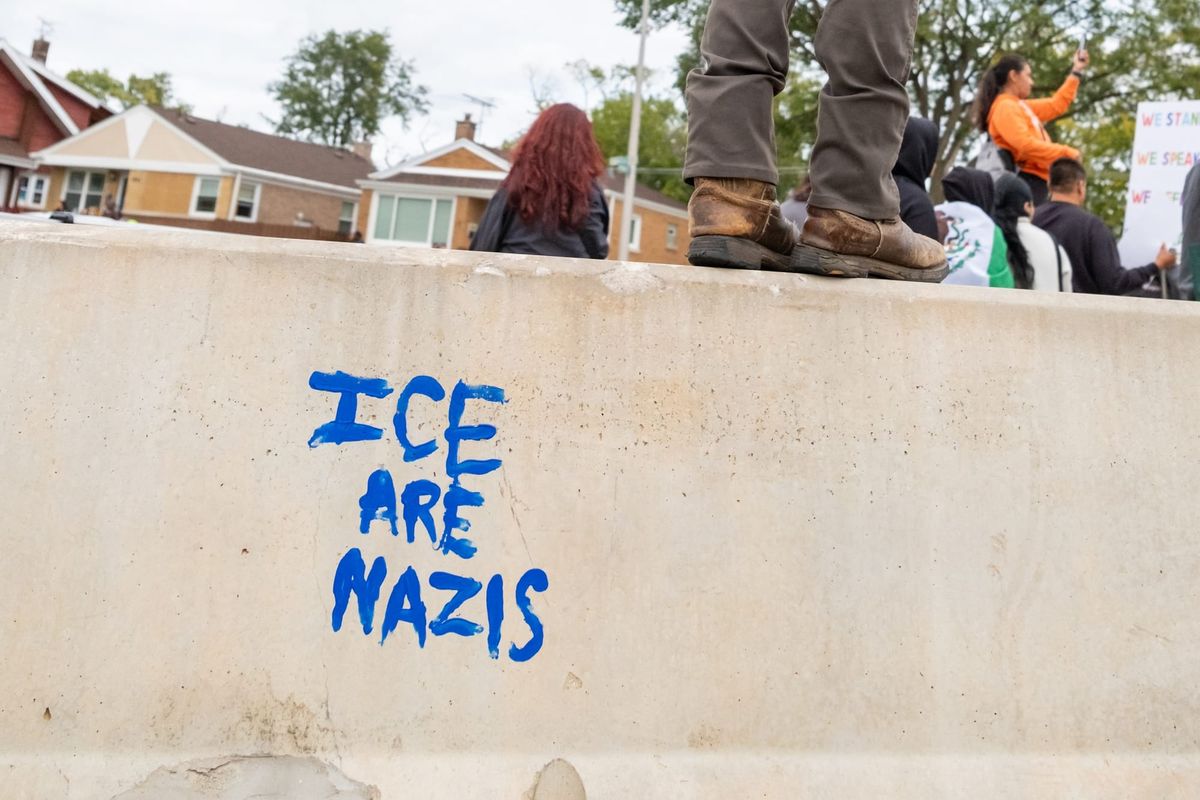
If you’re preparing for an onslaught of immigration enforcement in your city, here are some organizing resources you might find useful.
When the Feds Come to Your City: Standing Up to ICE: A Guide from Chicago Organizers — this was published in CrimethInc. and is understandably anonymously authored, but as someone who was involved in Chicago’s organizing, this is all very familiar to me, and I believe it’s a valuable resource.
Toolkit: How We Dealt with Border Patrol — created by Charlotte organizers, this resource offers a rundown of how activists there prepared and responded to ICE escalations.
A Guide to Finding Your People — this is exactly what it sounds like.
Block It! A Mini Toolkit to Take Action to Disrupt the ICE Kidnapping, Detention, and Deportation Machine – a fantastic resource from our friends at Interrupting Criminalization.
Emergent Security Advice against ICE’s Kidnapping Spree: A Practical, Timely, Semi-Local Guide to State Resistance — actionable security advice for activists facing federal invasions and escalations.
Mapping Community Defense and Care in Our Neighborhoods — this is a worksheet Chicago organizers used to prepare for federal incursions in the days before Operation Midway Blitz began, while the threat of a National Guard invasion was also looming.
I hope this week’s episode of Movement Memos will also serve as a resource for you all. I will be in conversation with three of my Chicago co-strugglers about what we learned from the struggle against ICE and authoritarianism during the recent surge of federal attacks and kidnappings here. This will be the last episode of Movement Memos this year, and it will air on Thursday (12/11).
Read This When Things Fall Apart Reading Groups
I am really grateful to everyone who has purchased Read This When Things Fall Apart: Letters to Activists in Crisis, and to everyone who has requested the book through their local library. If you are part of a book club that is reading the book, or if you plan to assign the book to your class in the spring, I will be available for Zooms with groups who wish to discuss the book (and/or Let This Radicalize You) this winter and early spring. There is no payment expected or required for these Zooms — I just want to support people’s efforts to engage with the book together. My availability from January through March will fill quickly, so please book my time while it’s available!
You can reach out through the contact page on my website (kellyhayes.org) to schedule a conversation.
An End-of-Year Zoom With Me
It’s been a minute since I’ve hosted one of my periodic Zooms for paid subscribers. The immigration enforcement surges in Chicago made it hard to schedule anything for weeks on end, as I never knew when I was going to have to run out the door to join community defense efforts. But on December 13 at noon CT, I will be catching up with folks again. If you are a paid subscriber, you should have received an invite via email yesterday.
If you think you’re a paid subscriber, and didn’t receive an invite, it’s possible your paid status has lapsed due to an expired credit card, or some other payment glitch. I will be sending another invite email on Friday, so if you’re not presently a paid subscriber, but want to join this end-of-the-year conversation, you can upgrade your subscription now via Ghost or Patreon.
I want to extend my sincerest thanks to the folks whose financial contributions make this newsletter possible. This newsletter now has over 10,000 subscribers, and only a tiny fraction of them are paid. While I will never put a paywall on my writing, the cost of producing the newsletter on Ghost increases as new subscriber thresholds are reached. So when people who can contribute choose to do so, you truly make this work possible for me — and accessible for everyone else.
Final Thoughts
What a fucking year, fam. We knew we were in for it at the start, and we weren’t wrong. I am so tired, I feel like I need new words to describe exhaustion. Fortunately, I am not burnt out, just in desperate need of rest. I know what burnout feels like. For me, it’s an empty, aching, exhaustion, where positive emotions can barely break through the hurt feelings, disappointment, and heartbreak that have sunk into every overworked fiber of my body. It’s the place where moral injury and overexertion intersect and hold us down. When I get there, I shut down, like an overheated engine, as though a mechanical failsafe has kicked in to prevent my destruction.
Burnout happens because our boundaries have been crossed, or we have crossed them ourselves, while also defying our physical and/or emotional limits. I can’t afford to get burnt out in these times, so I am taking the last two weeks of this year off — from everything. During those two weeks, I am going to watch trashy movies, eat my favorite foods, avoid the freezing temperatures outside, and cuddle with my partner and my cats. I am going to embrace laziness and try to laugh as often as possible.
Before I check out for the year, I am co-organizing one last upcoming event: a holiday party celebrating Chicago’s ICE watch volunteers and rapid responders. We are going to eat pizza and tasty desserts, raise a glass to our community’s ingenuity and courage, and sing karaoke. I am really looking forward to this event, and I hope others are thinking about how they can celebrate and uplift people who have thrown down hard this year in their communities.
This has been a difficult time for so many of us, with harms against immigrants, Black people, trans folks, unhoused people, and many others unfolding rapidly. From mutual aid to mass protest and community defense, so many people have risen to the moment and done their best to care for each other. Folks who funded abortions, planned meetings, organized actions, or otherwise did what they could, wherever they were, should be celebrated as we round out the first year of Trump 2.0.
There are many battles ahead, and one of the ways that we can help each other avoid burnout is to make space for joy, and remind people that they are seen and appreciated. So, as 2025 nears an end, I want you to think about what you need for yourself, in terms of time, space, rest, and rejuvenation — and also about what your community needs.
Who needs to be celebrated? Who needs to get silly together? How can this be facilitated? Whether that means writing a loving message, giving a shout out, or hosting a gathering where people’s efforts are named and praised, remember to acknowledge each other. As my friend Mariame Kaba says, “Sometimes you need to lift the choir.” Let’s remember to do that.
This is not an easy time to be a person who embraces hard truths, and moves through grief to take action. Next year won’t be any easier. So, I think this is an important time to think about what sustained us during 2025, and what we will need more of in 2026.
In my own life, I was sustained by my relationships, by music, and by the collective care and courage of people in my city. My cats and Star Trek reruns also played an important role in my emotional maintenance. I’ve invested myself deeply in my relationships this year, because the people I love, who love me in turn, make everything I am and everything I do possible. Hiking, singing and laughing with these people gives my life, and I am grateful for every minute I spend with them. A younger version of me might have made less time this year for laughter and unstructured fun with these people, and leaned more heavily on organizing time as quality time. This year, that would’ve been a catastrophic mistake. We needed every moment of humor, every hike in the woods, every song sung, every story told — because love, empathy and friendship are medicine for those striving to remain human in inhuman times. Do not neglect your relationships or your need to connect. Do not neglect yourself or your need for gentle, goofy, familiar, or inspiring energies.
Everyone needs a long haul plan to keep themselves intact amid intensifying fascism, authoritarianism, and the escalating assaults on our humanity. (If you need help formulating a plan, I’ve drawn up a writing exercise that might help.) We must take action, and we must take care of ourselves, and each other — and we must weave these tasks together into the fabric of our lives.
As I limp my way out of 2025, my back and shoulder are in better shape than they were a couple of months ago (shout out to my physical therapist), and my spirits are much higher than they were at the end of 2024, when I was holding so much dread about the coming year. I’m not saying the year wasn’t as bad as I thought it would be, because while that’s true in some ways, the buffoons that govern us got creative with their horrors, and the damage done has been severe. But I also see their weaknesses clearly now. While their coalition fractures, my community is getting stronger.
When our city was under attack, Chicagoans reached for each other and fought back. Chicago has given me so much hope over the last few months, as have resistors in Washington D.C., L.A., Charlotte, St. Paul, and New York — among others. There is no guarantee that we will strengthen the bonds we’ve developed in recent months, or build the infrastructure and frameworks we need to sustain and broaden our resistance, but I’ve seen our potential and I feel called by it.
I am not trying to downplay the severity of our situation. I feel the weight of this moment. I am grieving the people we’ve lost this year, and the lives that will yet be lost or destroyed by this fascist regime, and the fascist social fabric of this society. And still, I believe in us. I am inspired and renewed by our collective will to fight, and by the snapshots of possibility that have emerged in recent months. I am guided by active hope, and no matter how hard the day, or how long the odds, I will bet on us every time, because it’s the only bet worth making.
I’ll see you in 2026, friends.
Much love,
Kelly
Organizing My Thoughts is a reader-supported newsletter. If you appreciate my work, please consider becoming a free or paid subscriber today. There are no paywalls for the essays, reports, interviews, and excerpts published here. However, I could not do this work without the support of readers like you, so if you are able to contribute financially, I would greatly appreciate your help.