Nick Fuentes Wants Women in “Gulags.” Here’s Why That Matters.
"Gender has always been an important throughline of fascist politics," says Shane Burley.


Last week, far-right streamer Nick Fuentes openly called for the mass criminalization of women and girls. During an episode of his America First livestream on Rumble, Fuentes declared, “Just like Hitler imprisoned Gypsies, Jews, communists — all of his political rivals — we have to do the same thing with women … They go to the gulag first. They go to the breeding gulags.”
It would be easy to dismiss rhetoric this extreme as fringe theatrics. But Fuentes’ Groyper movement has come a long way from its meme-driven origins. The distance between its politics and the broader culture has narrowed, and its sexist, homophobic, transphobic, antisemitic, Islamophobic, and racist ideas have become increasingly normalized in public life. In the wake of Charlie Kirk’s death, Fuentes has been angling for greater influence within a conservative movement that is unsettled, divided, and shedding what few restraints remained.
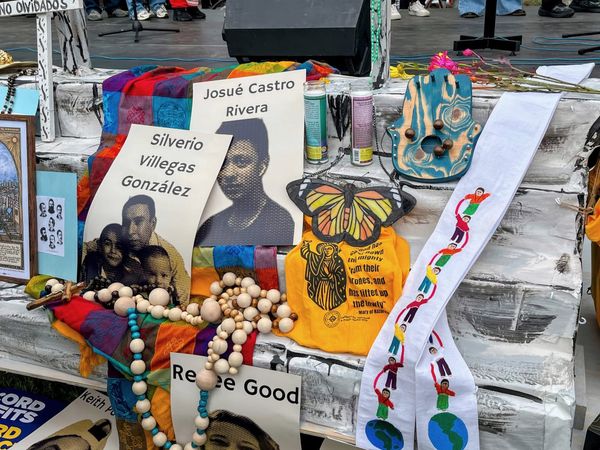
Misogyny and the scapegoating of women are not new territory for Fuentes, who helped popularize the phrase “your body, my choice.” However, his recent rhetoric feels especially unnerving following the murder of Renée Good. Good’s killing by a DHS agent was met with dismissals or mockery from right-wing commentators who critiqued her queerness, perceived disobedience, and physical similarity to women whose attitudes had displeased them. In a moment when the extrajudicial execution of a woman in broad daylight has been met with arguments that she had it coming, the construction of women as an enemy of the fascist movement — as figures in need of criminalization and containment — is particularly disturbing.
While we are not facing the imminent mass detention of women, this escalating language feels dangerous in our increasingly volatile political climate. So how seriously should we take Fuentes right now? And what does rhetoric like this reveal about the broader trajectory of the movement he’s trying to shape?
To think through these dynamics, I spoke with my friend Shane Burley, author of Fascism Today: What It Is and How to End It and Safety Through Solidarity: A Radical Guide to Fighting Antisemitism.
This interview has been lightly edited for length and clarity.
Kelly Hayes: Last week, on his streaming show America First, Nick Fuentes said, “Women get sent to the gulags first, obviously. Which women? All women. Every woman. Every woman and girl is sent to the gulags. We will determine who the good ones are after the fact.” Before we dig into the implications of that statement, I want to start with a grounding question: How seriously should we be taking Fuentes as a cultural and political force right now? He’s historically occupied a fringe position, but in the wake of Charlie Kirk’s death, he’s clearly jockeying for greater influence. How do you understand his current position within the right’s social and cultural hierarchy — and what does that position tell us about the broader trajectory of the movement?
Shane Burley: We should take Fuentes seriously as a voice of the young right, the edgier and less polished rhetoric that fuels them. Just as is true on the left, many people who work in the institutional world of politics and NGOs hold views more radical than they are allowed to express in their professional role. This is where Fuentes sits: he is the unfiltered, more energetic and undiluted voice of the American right. This is not altogether a new idea, the far-right has always been a key part of the larger world of American conservatism. The difference is that he has broken through some of the taboos (antisemitism, open race and IQ talk) and we are seeing his style of rhetoric and even ideas coming from institutions now housing young Republican professionals who came up on Fuentes-like media online.
With Kirk’s death, Fuentes makes up an influential portion of one piece of the conservative movement that is currently fracturing over questions related to Israel. In this Israel-skeptical faction, Tucker Carlson and Candace Owens are still more important, but Fuentes is connected to the younger group of men, many of which had a more professionalized experience with organizations like Turning Point USA but like that Fuentes gives them a language for their more radical urges. To the extent that the Republican Party becomes more openly questioning of Israel and increasingly rooted in the politics of white resentment, Fuentes will likely play an important role in shaping that shift.
Fuentes’ growing visibility seems to reflect a broader acceleration on the right. The extremity of this administration’s actions and rhetoric has sometimes outpaced the politics of conventional conservatives. That dynamic can pull people forward into support for escalating violence, but it can also alienate supporters. How do you see that tension playing out? Does this kind of overt eliminationist language signal strength, desperation, or both?
I think it signals both. There is nothing that can justify what Trump is doing with ICE and police right now other than white nationalism. The authoritarianism on display runs in the face of 50 years of Republican self-narration, particularly on the far-right where fear of government overreach became endemic in the 1990s. The only way it makes sense is if racial fears are the primary motivating factor, which is true for pretty much all of the party today. So I think Trump has a mandate from his base and he is filling it out.
The desperation comes from the fact that even amongst his supporters, they didn’t know just how ugly this would be. Trump has to double down or otherwise admit failure, so he really has no choice, and so what he does is not to tone down the violence, but to create a social media feedback loop that frames it as both courageous and joyous and to somehow make his supporters feel as though they are participating in it as passive warriors.
Turning to the ideological content of what he’s invoking: fascism historically draws on myths of national rebirth through purification and rigid hierarchy. How does positioning women as a political enemy function within that logic of enemy construction? What role does gender play in consolidating authoritarian movements?
Gender has always been an important throughline of fascist politics, particularly in creating a heroic narrative that men themselves can internalize and from which they can figure out how to perform masculinity. It is based distinctly on violence, but also on entitlement, what women are and what they should offer to men. By doing this it can capture resentment men feel, particularly the loneliness that comes from the lack of socialization for building relationships as well as just the reality of modern work life, and channel it back into their performance of masculine violence. If they feel alienated in their life, they are taught to blame women, thus putting pressure on the women in their life to engage in a kind of social reproduction that lets the system of alienation just continue further.
What this means practically is that social uplift and women’s autonomy is presented as directly threatening to male identity and is blamed for any material or emotional deprivation they have. Racial politics are obviously central for men, but gender politics play out in every man’s life on a daily basis and can act as a type of binding concept for keeping men occupied with violent behavior that serves the needs of the larger nationalist movement.
Fuentes makes up a particularly interesting, perhaps nihilistic version of this because earlier forms of fascist patriarchy are about forcing women into a narrow role of motherhood/spousalship that can reproduce a type of “traditional family.” Fuentes doesn’t even want that and celebrates himself as a virgin and blames women for the world’s ills. This likely comes from the deeply misogynistic world of Men’s Rights politics that has been a feeder for the groypers, but also reflects a type of skepticism from Fuentes of the ability to actually reclaim the traditional world he says he yearns for. He is filled with rage and blame and is unsure whether or not anyone, including himself, is capable of bringing about the revolution he believes to be necessary. He says this openly if you watch his conversations with white nationalists like Richard Spencer, where he sort of acknowledges that even he may be incapable of the traditionalism they lionize.
There is also a second element here of him simply seeing himself as what Julius Evola called “a man among the ruins,” a leader who sacrifices normative life to lead the struggle. So I think he likely justifies his own social ineptitude with an internal narrative that his role is not to compromise with a family but instead to lead the charge and therefore unremitting criticism towards women is possible since he will never have to actually soften enough to have a relationship with one.
In the same rant, Fuentes claimed there are “no trad ones or good ones” among women — collapsing even the idealized “traditional woman” into enemy status. What are the political, cultural, and social implications when extremist figures move from subordinating women to openly criminalizing or collectivizing them as a threat?
He has a mix of desperation and nihilism about the current possibility of rectifying a positive womanhood and also sees himself as a kind of destroyer who is not required to offer a positive vision of what types of relationships could exist in a glorious future. He is also reproducing a caste of men without attachments that can engage in the type of warfare, up to and including violence, that requires no restraint. So detaching them from women would be a good start to build that class. And he is also just speaking to an operative thought pattern in his target demographic: they hate women and they aren’t afraid to say it.
There is also a certain motivating factor to keeping an enemy in proximity at all times. This gets to how white nationalism has often seen itself, as a type of warrior ethos that has to constantly be responding to an enemy. And since they are seeking to transform men it is advantageous to present all women, more than half of the population and a piece of every man’s family, as a distinct enemy they are at constant war with. A life lived in warfare is what’s necessary to claim the Faustian spirit to make men great again.
Finally, what lessons from anti-fascist histories should guide our response to rhetoric like this? When movements begin openly naming entire categories of people as enemies to be imprisoned, what patterns should we recognize, and what mistakes should we avoid repeating?
The first thing that is important to notice is that while it is always a category of person that is named as an ontological enemy, it is not always the same category. Many project American racial dynamics on to fascism as a categorical constant, but it’s not. At times gender actually is the primary operating identity, or religion, or ethnic categories less present in American racialization. So it’s worth noticing these dynamics of blame and hatred even when they cross racial lines, as they do with modern misogyny.
The other thing is that misogyny is a foundational piece of modern gender construction, and therefore modern society. Fuentes isn’t inventing it or implanting it, he’s harvesting. It was already there and was built into the systems, and therefore not something extraordinary or coming from the outside. Antifascist movements have to be revolutionary to carry that label, which means that fighting the far-right should also be a pathway to confronting systems of power that we have accepted as the status quo for decades, or centuries.
There is also no end point for the categorical hatred of a type of person or dehumanization. That process takes on a life of its own and can become lethal all on its own. So we should see the writing on the wall every time a political actor expresses it. And while it’s more frightening when someone with state power expresses this, it should also be a priority to stop those who seemingly have none. Fuentes was just an online micro-celebrity, someone few paid attention to, and now he has an influence on state police. Even Trump was a reality show star, not the leader of the most powerful imperial country in the world. We should work to fight our enemies when they are weak so we don’t have to struggle to fight back when they’re strong.
And, finally, while the tactics may change when the far-right has state power, the overall ideas of resistance shouldn’t. Antifascism, particularly mass antifascism, is about building a tactic of interference with as many people as possible, whether it is to block fascist attacks or deplatform fascist rallies or stop the advancement of their organizing. We did that when they were Proud Boys, and we have to do the same thing now that they are ICE agents. It is just going to require a lot more of us.
I really agree with what you’re saying about ICE here, and I think we need to circle back to the concept of racialization, because that’s where the fantasies Fuentes is expressing are currently most accessible to this government — and to the right more broadly. What Fuentes is really talking about is scaling up the violence of criminalization, which is highly racialized. Through the violence of policing, immigration enforcement, and criminalization, we can already see the mechanisms that allow women to be confined, to have their bodily autonomy stripped away — even to be prevented from traveling to places where greater freedom might be possible.
The women taken by ICE, the women molested by prison guards, the girls ripped away from impoverished or immigrant mothers, all of this reflects the fascist fabric of the system, the inner lining of the suit this country wears. While we absolutely have to rage against the violence enacted upon Renée Good, we also have to raise hell about the shooting of Marimar Martinez — a teaching assistant who was shot five times by a Border Patrol agent in October in Chicago. Martinez survived, but I don’t think her survival is the only reason we’ve heard less about her case.
When Black and brown women are killed or abused under this system, especially by law enforcement, that violence is simply less visible to many people. And as you’re saying, to fight fascism, we have to do more than rage against what feels new or obvious. We have to confront the dehumanization that is being expanded, exploited, and supercharged in this moment.
Organizing My Thoughts is a reader-supported newsletter. I’ve been losing a significant number of paid subscriptions lately as more people face financial strain, and I completely understand that reality. These are hard times, and I hope we all see better days soon. Paid subscriptions are what allow me to keep this work accessible to everyone, because I won’t put it behind a paywall. If you’re in a position to pitch in and support the creation of these letters, interviews, essays, reports, and lists, I would be grateful for your support.