“We Belong to Each Other Now”: Lessons from Minneapolis
“This extreme closeness, togetherness and intimacy — you cannot infiltrate your way into a space where you'll understand that," says May, a rapid responder in Minneapolis.

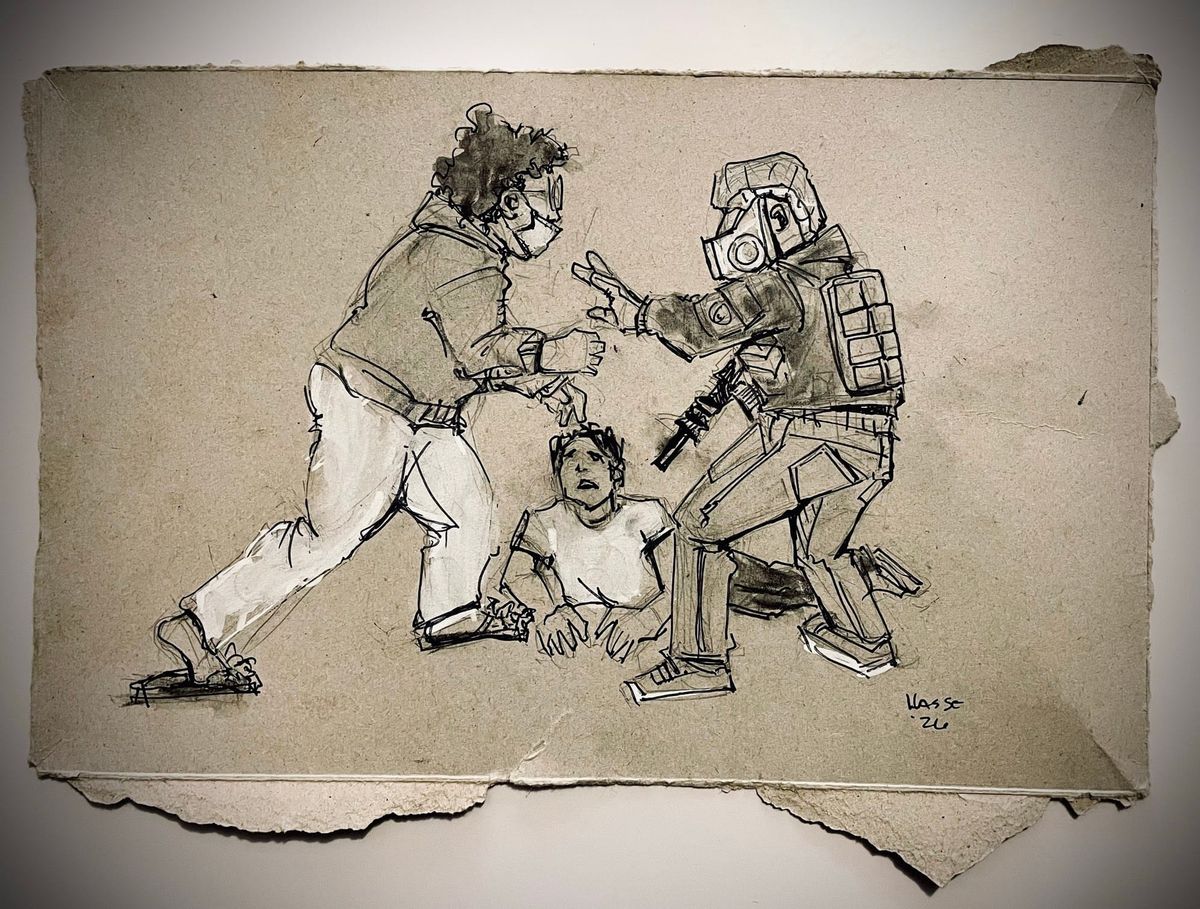

Author’s Note: All interviewees are identified by assumed names due to safety concerns.
Official narratives can be deceiving, and that is especially true in this political moment. The Department of Homeland Security has declared that fewer than 500 federal immigration agents are currently deployed in Minnesota, after announcing that its monthslong assault on Minneapolis and surrounding areas, dubbed Operation Metro Surge, was coming to an end. But as Francis, an organizer with the rapid response group Defend the 612 told me, “500 is, without a doubt, still a surge.” Francis pointed out that the first “surge” Minneapolis saw in December was an influx of 150 agents. A force numbering in the hundreds — several times larger than that initial deployment — is not a retreat. It is a tremendous enforcement footprint in a single metropolitan area, and a force capable of inflicting mass terror, carrying out targeted abductions, and sustaining a climate of fear.
This is how authoritarian governance works: when backlash makes extremity costly, the state dials it down just enough to shift the narrative, and what remains is recast as normal. When I spoke recently with members of Defend the 612, a rapid response network in South Minneapolis, this tension framed their reflections on what officials are calling an ending.
Melvin, a business owner who has lived in South Minneapolis for 20 years, told me, “For at least a week there has been less activity in South Minneapolis, but there are still abductions and kidnappings happening periodically.”
Members of Defend the 612 described a shift in federal deployments, as more abductions were occurring in the “further suburbs” and late at night. With less spectacle, more dispersion, and a narrative of withdrawal, federal agents remain embedded in the area, establishing a new baseline for attacks on the local immigrant population.
As Sasha, a rapid responder who is also a state government employee, pointed out, there is no reliable, official accounting of how many immigrants are being abducted. “Nobody’s tracking this information. The city governments aren’t tracking it. No entity of the government is tracking it. Our view of the problem is limited to the observations of humans who are looking for it.”
While the corporate press embraces the narrative that the crisis in Minneapolis has passed, these organizers are steeped in the lived reality of an ongoing struggle. However, as the pace of their local response work has become less breakneck, some members of Defend the 612 welcomed the opportunity to sit down and discuss the lessons they’ve learned, the grief they carry, and the sense of belonging and fellowship they hope will endure in their communities.
A Practical Lesson: Speed Matters
A couple of weeks ago, ICE agents got chatty with some volunteer observers they had taken into custody. The agents revealed that they had tracked the rapid response times of volunteers who were showing up to oppose their work across Minneapolis. According to Francis, “[ICE agents] had timed out the rapid response time in Minneapolis in general to be about seven minutes and on the South Side specifically to be about two minutes.”
Members of Defend the 612 said this account was consistent with their own observations that abductions in South Minneapolis had ramped down recently, even as attacks in other communities remained intense. They believed ICE agents had adapted to the terrain of struggle by calculating where they could operate with the least friction.
The group said that approaches to operational security, or “opsec,” were an important factor. Autonomous groups across Minneapolis have adopted different approaches to vetting, with some groups maintaining communication channels that were 100 percent vetted, and others creating channels that included as many community members as possible, without any vetting process. A rapid responder who identified themself as “Joe” observed that neighbors that had unvetted chats had the fastest rapid response times. “There are benefits to vetting and I do think we need highly vetted chats, but having some unvetted chats is also very useful,” they said.
This observation was consistent with my experiences in Chicago during Operation Midway Blitz. While some vetted lines of communication are necessary, in order to discuss sensitive information, having some unvetted channels that recruit as many neighbors as possible into shared vigilance allowed for a massive presence in the streets.
A Defend the 612 member who identified herself as “Margaret” described tensions between some groups and community members around the question of vetting. “Different groups made different choices and there's some tension there that we may never resolve, frankly, because those choices were made for good reasons.” Margaret explained the tradeoff between different approaches by saying, “You can get a lot of people, you can get them fast, or you can have great opsec. You can't have all three of those things.” While opinions on this subject vary widely, Margaret explained that in her community, strategy was shaped by necessity. “In the neighborhood that a lot of us live in, Powderhorn-Phillips, we were hit so hard. We needed numbers. It’s really hard to stop an abduction with two or three neighbors. It's actually really easy to stop an abduction with 10 neighbors, but you need a lot of people to make that happen consistently.”
For Margaret, the lesson was clear: “Mobilize everybody.”
Don’t Wait for Permission
One hurdle that local organizers had to overcome was the hesitancy of some residents who felt unqualified to take action. Some community members were reluctant to so much as blow a whistle, to alert their neighbors to the presence of ICE agents, unless they had attended a training. Responders described the need for outreach that allowed residents to embrace their own agency — a process that sometimes had messy results, but often resulted in essential, creative interventions. “You don't need to wait for nonprofit directors, leaders, or block captains, or a more organized neighborhood to give you permission,” Melvin explained. “Just get out there and do it.”
To take bold action, group members argued, we must overcome our ingrained obedience to authority. Sasha noted that under a “tyrannical authoritarian regime” like the Trump administration, an allegiance to authority was utterly self-defeating, and that a posture of disobedience was essential. She noted that “authoritarian structures” already exist in the minds of people living under capitalism, because “we live in a world that robs us of connection, agency, creativity, and energy.” To participate in actions as risky and defiant as tailing ICE agents, a kind of internal liberation is necessary.
One group member admitted that she followed ICE vehicles while honking loudly so often that her car horn broke.
Melvin noted that when collective action diminishes the effectiveness of ICE agents, their legitimacy is undermined. “These are not Robocop, storm trooper, superhuman people,” he said. “These are just dumb shits with pepper spray and guns. They're just like your dumb cousin or whatever. And everybody needs to see that.”
While not everyone can engage in risky frontline tactics, Sasha emphasized that there is a role for everyone in this work. “There’s a spot for literally every person who gives a shit about humanity to do something really useful,” she said.
Community Defense Is an Ecosystem
While confrontations between rapid responders and ICE agents draw a great deal of public attention, there is a largely unseen web of care work, communications, healing, and fellowship that make a sustained effort like the resistance in Minneapolis possible. Members of Defend the 612 described teams of volunteers fixing doors that had been broken down during raids, or performing repairs for tenants who were afraid to make complaints to their landlords during the surge. Networks of public school parents coordinated mutual aid for immigrant families in need. Healing spaces and community dinners offered crucial respite for weary, traumatized volunteers. In some cases, exhausted rapid responders received help with household chores or meal preparation. Joe noted that this kind of assistance involved a kind of intimacy. “We’ve had to be okay with people coming in and seeing our really messy house so that we can accept that help,” they said.
An organizer who called herself “May” explained the importance of naming the often invisibilized care work of struggle. “The labor of sustaining families through prolonged crises often falls disproportionately on Black and brown people, queer people, and women and femme people.”
May worries that the changing shape of the struggle may mean that organizers who are supporting families in crisis will have less support. Noting that the emergency “will look different and feel different” in the coming months, she stressed that the care work and mutual aid that families have needed, in order to navigate so much “trauma, grief, and loss” must endure. “What will we be able to do to continue to hold families who have been experiencing such trauma and grief and loss? I mean, I feel hopeful, but I also feel a little worried about that.”
The rapid responders I spoke with also expressed concerns that the normalization of present conditions could lead to a ramp-down of material support from outside the state. During Operation Metro Surge, many immigrant community members have been unable to work. Families in hiding are increasingly facing the threat of eviction, and the donations volunteers have distributed were already inadequate to meet the scale of need.
In Minneapolis, fundraising has not been an auxiliary effort. It has been a frontline response. The volunteers I spoke with embraced a broad definition of community defense. They saw their work confronting ICE agents as interwoven with fundraising, childcare, legal filings, food distribution, transportation, and the ongoing work of emotional regulation during a time of crisis. Joe noted the role of lawyers filing habeas petitions that prevented people from being moved out of state within hours of detention. Being part of that fabric of care and defense, they argue, has altered residents’ sense of who they are to each other.
Francis believes that change will endure. “This is who we are now. We have gained so many people into a community of love and care. I just don't see that changing.”
The Word Neighbor Changes
Near the end of our conversation, May reflected on language: “You hear the word ‘neighbor’ here a lot. I think that word has started to mean something different.”
Francis connected that shift to a deeper kinship. “Within the Native community they use the word relative. These are our relatives. It's this patterning of kinship. We belong to each other now in a way that we weren't sure we could count on before, and Minneapolis is forever changed.”
May described scenes in the streets where neighbors demonstrated their regard for one another. During one incident, where tear gas was deployed, she recalled observers taking off their gas masks and giving them to people they perceived as more vulnerable than themselves, including elderly neighbors. Margaret described a confrontation, on the day of Renée Good’s murder, when 200 residents joined together to force ICE to leave the immediate vicinity of a school. The group was traumatized by Good’s violent death. They were grieving. They had been tear gassed. Some had been brutalized. But upon recognizing the strength of their numbers, they made a decision: to collectively walk toward the ICE agents they were squaring off with. “They started backing up,” she said. The agents continued their slow retreat in the face of the advancing crowd for about four blocks before leaving the area. “They didn’t come back to the school that day.”
Such actions were not undertaken lightly.
The stakes of action in Minneapolis have been high. Renée Good and Alex Pretti lost their lives while participating in community defense efforts. Julio César Sosa-Celis was shot in the leg by an ICE agent in North Minneapolis. Even before Operation Metro Surge escalated, federal immigration agents had killed Silverio Villegas González in Franklin Park, outside Chicago, and shot Marimar Martínez five times in Chicago’s Brighton Park neighborhood after she followed their vehicles and repeatedly honked her horn to alert residents.
“There were thousands of us out there before Renée was murdered,” Margaret explained. “The day after Renée was murdered, there were tens of thousands. Tons of new people came into this knowing they could die, because we saw it on video, and it didn't stop them.” Margaret stressed that the collective courage on display in Minneapolis shouldn’t be construed as a lack of fear, but rather, as a willful, collective persistence. “Almost everyone I know has been pepper sprayed or tear gassed or both in the last two months, including people I never would've guessed,” she said. “They go home, they wash out their eyes, they decontaminate their clothes, and they go back out. They get threatened by federal agents, who break their car windows, and they fix their car windows, and go back out the next day.”
In a solemn moment of our conversation, Joe talked about volunteers who had drawn up wills for the first time, in the wake of Renée Good’s killing, “in case they didn't come home to their kids.”
While the rapid responders I spoke with were proud that Minneapolis did not cower in the face of deadly repression, but instead sprung into greater, more determined action, they also warned people in other cities not to wait for a heartbreaking, galvanizing event before organizing fiercely. “Two of our neighbors are dead, another person was shot in the leg,” Sasha said. “We shouldn't wait until they kill the next person to be as fucking pissed off as we all collectively have been about this situation.”
What They Cannot Infiltrate
As someone who has seen repression fracture movements and frighten people away, I was struck by what happened in Minneapolis after Renée Good was killed. Instead of thinning, the crowds grew. What was it about this moment that made state violence an activating force rather than a demobilizing one?
May attributes the community’s resilience to bonds forged in shared presence — in kitchens, on sidewalks, at memorials. She emphasized that this connectedness, the longing people feel for it, and the strength they draw from an embodied sense of belonging, is something the MAGA right simply cannot understand. “Our opposition calls us paid protesters,” she said. “They cannot comprehend or understand that this is coming from the deepest corners of people’s souls. They cannot get their heads around it.”
May noted that the right’s inability to understand “why an old auntie would be walking around Alex Pretti’s memorial pouring coffee for strangers in subzero temperatures” is one of the movement’s strengths. “They'll infiltrate the Signal groups or whatever, but what they cannot actually fucking understand is how people are relating to each other. This extreme closeness, togetherness and intimacy — you cannot infiltrate your way into a space where you'll understand that.”
Organizing My Thoughts is a reader-supported newsletter. I’ve been losing a significant number of paid subscriptions lately as more people face financial strain, and I completely understand that reality. These are hard times, and I hope we all see better days soon. Paid subscriptions are what allow me to keep this work accessible to everyone, because I won’t put it behind a paywall. If you’re in a position to pitch in and support the creation of these letters, interviews, essays, reports, and lists, I would be grateful for your support.