When the Headlines Change but the Violence Doesn’t
“This is not a cruel novelty project. It’s infrastructure, designed for permanence and expansion.”


Greetings friends,
This week, the federal government announced that it would draw down the ICE presence in Minneapolis, removing 700 immigration agents from the city, in a move the administration portrayed as de-escalation. In reality, that reduction still leaves roughly 2,000 federal agents operating in the Twin Cities, and local organizers report that ICE and Border Patrol are still aggressively targeting immigrants and community observers.
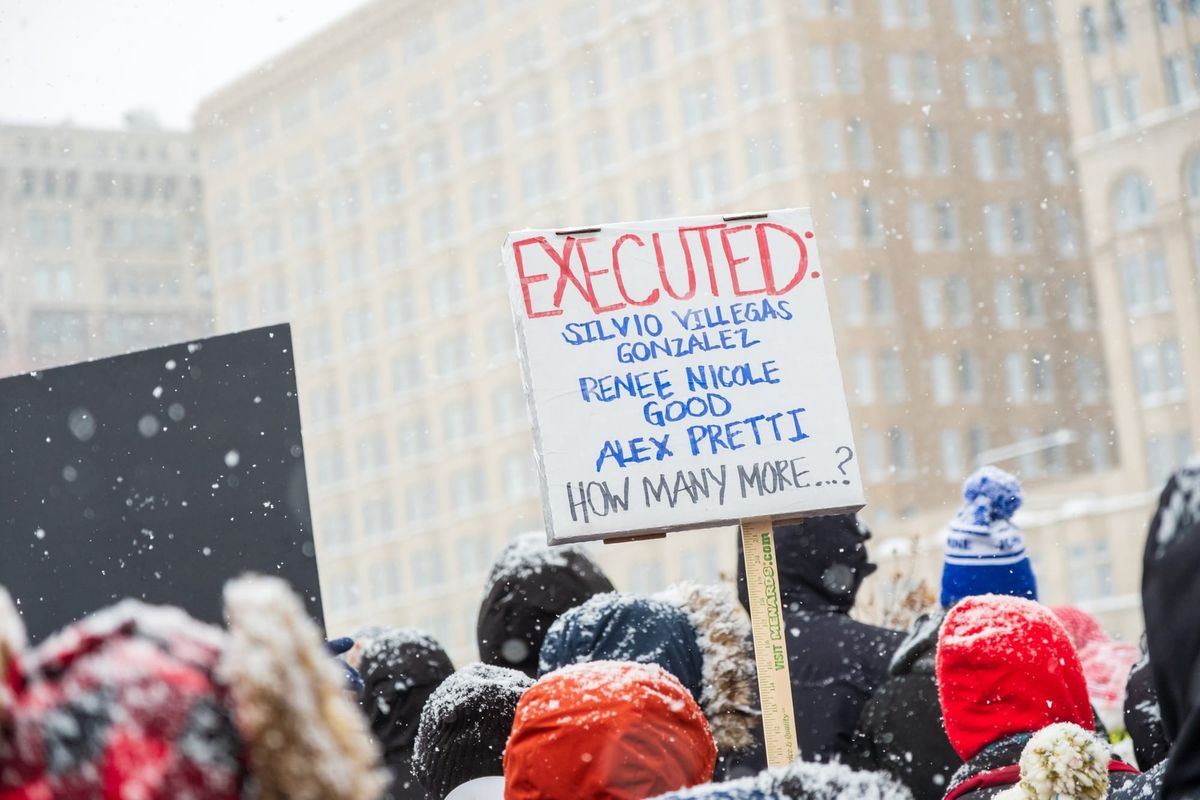
In the wake of Alex Pretti’s murder, which has provoked more bipartisan blowback than the killing of Renee Good, DHS is reshuffling some agents while Trump talks about using a “softer touch” for immigration enforcement. Given that most headlines have emphasized the 700 agents who will be exiting Minneapolis, rather than noting the thousands who will remain in the city, the administration’s damage control efforts might have helped buy a quieter news cycle or two — if the president hadn’t posted a racist video depicting the Obamas as apes.
From ICE agents leaving “kill cards” when they abduct immigrants in Denver to the white supremacist-coded skull masks agents have been wearing — and the president’s taste in videos — this government simply can’t help itself. In a country where politicians can endorse genocidal policies without being accused of bigotry or bias, these people can’t stop underlining their character and the severity of their agenda.
While some efforts were made to smooth things over with the media this week (talk of softening immigration enforcement, blaming an unnamed staffer for the racist video), when it comes to immigrants, this administration’s mission has not changed. With a budget battle underway, and polls showing increasing opposition to ICE and Trump’s immigration policies, Republicans want to shift the narrative. But as political commentator Thom Hartmann recently pointed out, rather than sacrificing their objectives, authoritarians use “compromise” to recalibrate their efforts. Hartmann describes the unsteady, at times sloppy progression of fascism, explaining that leaders “climb an inch up toward fascism, get pushback from the public … back down a half-inch until things quiet down, then move up another inch … toward the ultimate goal of total tyranny.”
When a fascist inches forward again after pivoting or appearing to make a concession, their aggression often feels less shocking, and generates less pushback.
What our enemies are building is a sustained political project. They may scale down their operations in particular cities, as they did in Chicago, at least temporarily, or throw some of Trump’s lackeys under the bus — as they did with Gregory Bovino, when the public wasn’t buying the administration’s lies about Alex Pretti. But they are building a massive concentration camp apparatus, and they will not abandon the objective of filling those camps. As journalist Pablo Manríquez recently exposed, the Navy is reshuffling funds under an existing contract vehicle to designate $45 billion dollars for the construction of a new “sprawling network” of detention facilities. This contract maneuver bypasses potential procedural delays, making funds steadily and immediately available for the construction of what Manríquez calls “self-contained cities” which would each house as many as 10,000 people in soft-sided tents.
This is not a cruel novelty project. It’s infrastructure, designed for permanence and expansion.
The number of people in immigration detention has soared from 40,000 to 66,000 under Trump 2.0, a 75 percent leap in just one year. But this is only the beginning. As journalist Andrea Pitzer, author of One Long Night: A Global History of Concentration Camps, recently observed, the administration has been working to expand detention capacity toward a scale that could hold as many as 100,000 immigrants. Pitzer noted that the existing carceral system, and the legacies of Japanese internment, Native genocide, Jim Crow, and other historical injustices in the US all created a climate in which Trump’s concentration camp system for immigrants could be organized. Now, she argues, we are acting within a limited window in which it is still possible to actively and successfully challenge the continued rise of that system.
The camps are already here, and the system is being entrenched and expanded, but public resistance to the abduction of our neighbors and solidarity with imprisoned migrants are escalating as well.
At the Otay Mesa Detention Center in San Diego, neighbors are holding vigils, and communicating with immigrants who are imprisoned at the facility. As Aisha Wallace-Palomares recently reported, some detainees have begun tying messages to lotion bottles, and throwing them over the walls and fences of the detention center, in order to communicate with people holding vigil outside. Notes often include the “A numbers” of detainees, which allow supporters to add commissary funds to the accounts of people inside. Detained immigrants who supporters have communicated with have described prolonged periods of being out of contact with their loved ones, due to a lack of funds. They also report extremely limited access to their attorneys and seemingly indefinite legal delays. One message from a prisoner read: “It’s cold here all the time and the food is poor … For 280 days we haven’t eaten a single piece of fruit, banana, apple, orange, or anything fresh. We are all in one big room with no doors or windows. We can’t see any grass or trees. We are all constantly sick.”
“We are all constantly sick.”
Thirty-two people died in ICE custody last year, making it the deadliest year of ICE detention in decades. As Maya Schenwar and I wrote in 2019, during Trump’s first family separation effort, it’s important to hold multiple truths: Trump’s camps are concentration camps and they are also prisons. Understanding the role that prisons play in manufacturing premature death in the United States is crucial to understanding how deadly this regime’s current plan for carceral sprawl will be.
Each year spent in a U.S. prison takes two years off a person’s life expectancy. With over 2.3 million people imprisoned, incarceration has shortened the overall U.S. life expectancy by five years. Given that Stephen Miller, our shadow president, fetishizes white genocide narratives, in which mass violence against immigrants is positioned as the only means of preserving Western civilization, we should expect these death-making norms to escalate in the Trumpian concentration camp system by design.
People will always be sick, and many will die.
The more this system sprawls, and the more people disappear into its organized disorder, the more its reach will expand. A supercharged ICE, already enmeshed with other federal agencies, will increasingly arrest people who are not immigrants, and rather than releasing or charging citizens, people with legal status may find themselves funneled into the same concentrated system of disposal being constructed for immigrants.
To the Stephen Millers of the world, those who resist violence against immigrants are equally deserving of that violence.
We aren’t there yet, and as Pitzer tells us, we still have time to organize and build power in opposition to these outcomes, but we cannot deceive ourselves about the scope or scale of this struggle. The current movement of community defense against ICE has emerged city by city, and neighborhood by neighborhood — and much of that organizing has been reactive, in response to an immediate threat. That is an assessment, not a criticism. I am in awe of the work people have been doing, and that work must continue. In fact, it’s the most hopeful resistance to fascism we have seen during Trump’s second term, but we must be clear about the scale of what we are up against, and we cannot allow ourselves to become spectators, centering all of our attention on whatever city is the current epicenter of roving ICE attacks. We must recognize that this is a broad, long struggle, and that its fronts are everywhere.
We must also recognize that the Democrats are not offering or advancing anything with the potential to stop this violence, and may not want to, given that the administration appears to be throwing away the midterms with both hands. That assumes, of course, that Trump would accept those electoral failures without a fight — an outcome that is by no means guaranteed.
We are seeing some resistance to the creation of concentration camps, even in Trump-friendly areas, and that resistance is encouraging, but we have a long way to go to build a movement against this death-making campaign of violence and human disposal. To move forward, we have to ask critical questions. How can we disrupt the construction of concentration camp infrastructure? What systems must be disrupted to undermine this fascist regime? What alliances must be formed? How can we organize both offensively and defensively in these times?
I will be discussing these issues further in an upcoming conversation with Andrea Pitzer for Movement Memos.
ICYMI
This week on Movement Memos, I talked with three Minneapolis organizers, including Andrew Fahlstrom and Susan Raffo, about community defense in Minneapolis, the social fabric of collective care under federal occupation, and how people around the country should be gearing up for the long struggle ahead. I think this is one of the most important episodes we’ve made in a long time, and I hope you’ll check it out. You can listen to Movement Memos wherever you get your podcasts.
Resource: Activist Checklist for ICE Watch and Rapid Response
The website Activist Checklist has created an updated security checklist for anyone “observing ICE's activities to hold them accountable: filming, foot patrols, adopt-a-corner, or rapid response.” There’s a lot of bad discourse about operational security right now, and I’m not going to delve into all of that here, but I wholeheartedly believe that everyone who is doing ICE Watch and Rapid Response work, or who wants to be ready to do so, should work their way through this checklist. Community defense is about working with our neighbors to create as much safety and justice as we can. Putting digital safeguards in place is part of that work.
Must-Reads
Here are some of the most important articles I’ve read lately.
- Bannon Calls for ICE to Engage in Voter Intimidation During the Midterms by Sasha Abramsky. “You’re damn right we’re gonna have ICE surround the polls come November,” former Trump strategist Steve Bannon said.
- DOJ Orders Emergency Surge Prosecutors From All US Attorneys by Ben Penn. “The Justice Department is requiring all US attorneys to rapidly assign prosecutors for ‘emergency jump teams’ supporting districts handling alleged assaults or obstruction of law enforcement, according to an internal memo obtained by Bloomberg Law.”
- Trump DOJ Files 9/11-Era Charges Against Leftists Across the Country by Josh Kovensky. “Across the country, federal prosecutors are upgrading what would have been routine prosecutions into terrorism cases when they involve people President Trump has cast as his political enemies.”
- ‘It Seemed Like Time Stopped’: Marimar Martinez Recounts Shooting by Immigration Agent at Washington Forum by Jason Meisner. “‘I am Renee Good, I am Alex Pretti, I am Silverio Villegas Gonzalez, I am Keith Porter,’ she said. ‘This needs to stop now. How many more lives must be lost before meaningful action is taken?’”
- Supreme Court Is Going to New Lengths to Hide Its Inner Workings From Scrutiny by Marjorie Cohn. “Although employees of the court have long been compelled to remain silent about what happens behind the scenes, the new nondisclosure agreement requirement is stiffer than prior agreements employees had signed.”
- The UK’s Anti-Migrant Right Is Surging. Local Elections Will Test Their Power by Sasha Abramsky. “The Labour Party’s strategy, pushed by Home Secretary Shabana Mahmood, is to take the wind out of the Reform U.K. Party’s sails by co-opting some of its more toxic policies around immigration, even if the impact is to drive away needed workers, in health care and other industries, who can more easily get residency rights in other countries in Europe and beyond.”
- Life and Loss in Umm al-Khair, an Island Within a Settlement by Ali Awad, Rafaela Cortez and Ricardo Esteves Ribeiro. “The West Bank community of Umm al-Khair has been consumed by the illegal Israeli settlement of Carmel. But despite losing land and loved ones, Palestinians there refuse to leave. ‘This is my land,’ says Ahmad Hathaleen. ‘This is where I belong.’”
- As ICE Terror Forces People Inside, Calls Grow for Eviction Moratorium in Minnesota by Theia Chatelle. “‘Operation Metro Surge’ has left thousands of families sheltering in place from masked federal agents roaming the streets. With many afraid to go to work or school, bills are piling up, galvanizing calls for Minnesota Gov. Tim Walz to declare an eviction moratorium.”
In Closing…
If you would like to make a donation in support of communities under siege in Minneapolis or Maine, you can visit the Stand With Minnesota website or make a donation to the Main Solidarity Fund. Even small donations add up.
If you can’t donate, please remember to do whatever you can, wherever you are. All of our hands and hearts are needed right now.
Much love,
Kelly
Organizing My Thoughts is a reader-supported newsletter. I’ve been losing a significant number of paid subscriptions lately as more people face financial strain, and I completely understand that reality. These are hard times, and I hope we all see better days soon. Paid subscriptions are what allow me to keep this work accessible to everyone, because I won’t put it behind a paywall. If you’re in a position to pitch in and support the creation of these letters, interviews, essays, reports, and lists, I would be grateful for your support.