Minneapolis Community Defense Is “Riding on the Learning Edge of a Whirlwind”
“We are becoming the people that we always knew that we needed to be,” says Minneapolis organizer Andrew Fahlstrom.

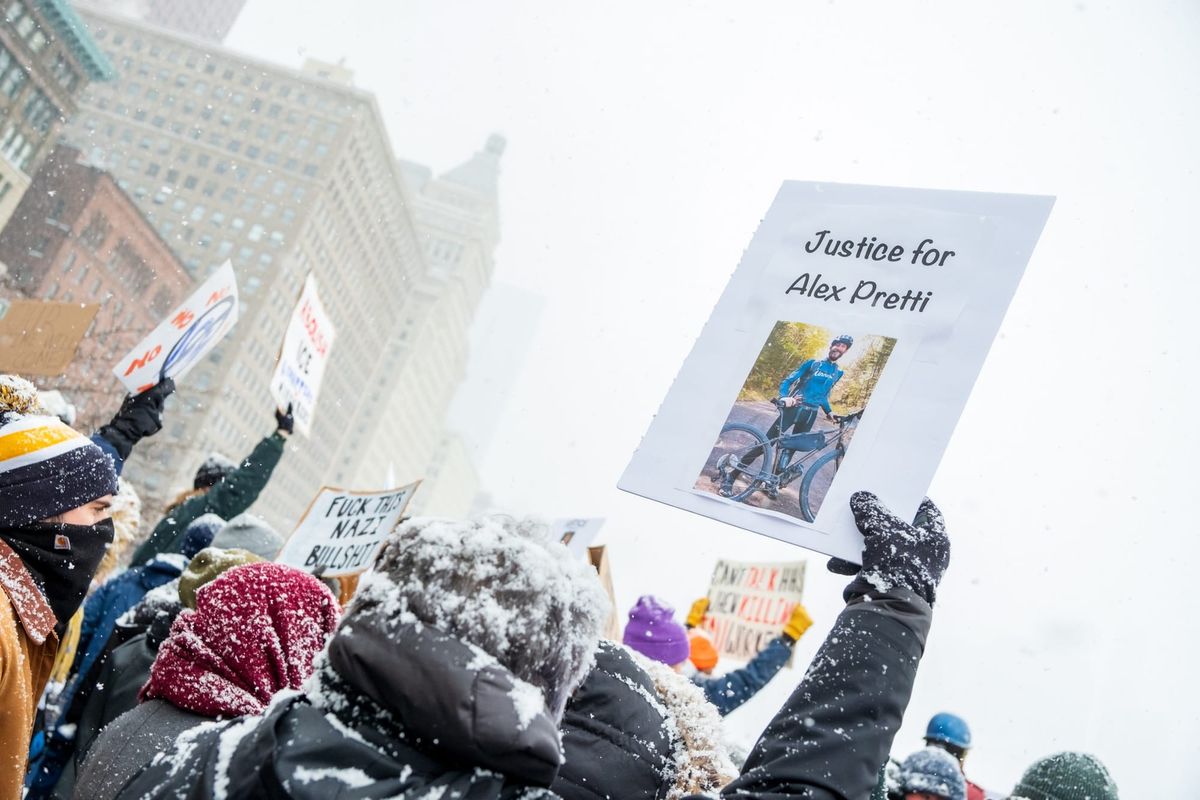
"Our days are riding on the learning edge of a whirlwind — crisis management, harm mitigation, helping everyone come to terms with new conditions and new impossible choices that they’re faced with,” says Minneapolis organizer Andrew Fahlstrom. In this episode of Movement Memos, I talk with Andrew and local organizers Jordan and Susan Raffo about community defense in Minneapolis, the social fabric of collective care under federal occupation, and how people around the country should be gearing up for the long struggle ahead.
Music by Son Monarcas, Daniel Fridell, and Katori Walker.
TRANSCRIPT
Note: This transcript was originally published in Truthout. It is shared here with permission.
Kelly Hayes: Welcome to “Movement Memos,” a Truthout podcast about organizing, solidarity, and the work of making change. I’m your host, writer and organizer Kelly Hayes. Today we are talking about the federal occupation of Minneapolis, where three people have been shot by federal agents – two fatally – and thousands of immigrants have been detained. We’ll be hearing from writer and healing justice practitioner Susan Raffo; Andrew Fahlstrom, a rapid response organizer with Defend the 612; and Jordan, an immigrant organizer whose works includes digital security and mutual aid.
In the Twin Cities and surrounding areas, we have seen an escalation of fascist violence that reflects the race war fantasies of men like White House adviser Stephen Miller, who would see immigrants and their defenders ground under. However, Minneapolis is also the heart of another arc of escalation — a mass activation of care and community defense and resistance that signals hope for us all.
Last week, some observers welcomed news that Border Patrol commander Greg Bovino was reassigned out of Minneapolis. The move followed the fatal shooting of Alex Pretti by federal agents and a wave of public backlash. The conversation you’re about to hear was recorded the day after Pretti’s death, prior to the announcement about Bovino’s departure. Unfortunately, the issues we discuss here — the violence, the lack of accountability, and the urgent need for steady, strategic responses from movements and communities — remain as relevant in Minneapolis today as they were the day after Pretti’s killing. Activists on the ground in Minneapolis have described Bovino as a “sadist” and a “fascist abuser,” whose departure has been felt on a personal level, but note the character and intensity of their struggle has not changed in the wake of his departure. Brutal attacks on their communities are ongoing, while ICE attacks in other states continue to escalate as well.
This is a time to be strategic, and to learn all we can from each other, because all of our communities need to prepare for the kind of state violence that Minneapolis is facing right now.
If you appreciate this podcast, and you would like to support “Movement Memos,” you can subscribe to Truthout’s newsletter or make a donation at truthout.org. You can also support the show by subscribing to “Movement Memos” on Apple or Spotify, or wherever you get your podcasts, or by leaving a positive review on those platforms. Sharing episodes on social media is also a huge help.
Truthout is an independent news organization, publishing stories that the craven corporate press won’t touch. We are a union shop with the best family and sick leave policies in the industry, and we could not do this work without the support of readers and listeners like you. So thank you for believing in us and for all that you do. And with that, I hope you enjoy the show.
[musical interlude]
KH: Jordan, Raffo, Andrew, welcome to “Movement Memos.”
Susan Raffo: Good to be here.
Jordan: Thanks for having us.
Andrew: It’s good to be here.
KH: To help frame this conversation for our audience, can each of you take a moment to introduce yourself and tell us a bit about the organizing work you’re involved with?
Jordan: So my name is Jordan. I’m an Ethiopian Eritrean immigrant from my mother and my father’s side. I am a transplant to Minnesota. I came here a few years ago. At this point, I feel like it’s my second home. I’m a two-culture kid in that way, but my family has been immigrating to Minnesota, but also the U.S. since the ’70s, the late ’70s and early ’80s.
My work, I feel like right now it’s shaped as a community organizer in 2026, but a lot of my work focuses on relationship building, setting up care infrastructures, capacity building, political education work. And most recently in the last three, four years, a lot of tech justice work with the heightened surveillance and just AI or production work. Yeah, that’s me. Nice to be here.
SR: I am Susan Raffo. I go by Raffo. I do a lot of my work through REP [Relationships Evolving Possibilities], which is a project that emerged in 2020 during the uprising. We do a lot of work around collective safety, both through political education and skills building.
In the moment that we’re in right now in the Twin Cities, there’s a lot of work that I’m doing that is about connecting people to care. So what are the things that we need that are going to make us sustainable for the long-term, recognizing that this is not stopping tomorrow. That includes everything from dealing with shock trauma, to grief circles, to supporting people who are doing on-the-ground work or frontline work in different ways. And that’s how I’m showing up in this conversation.
Andrew: My name’s Andrew. I have lived in Minnesota for almost 45 years now. And the work that I’m involved in, in this moment, besides parenting a teenager, trying to be in a healthy partnership, and live through occupation, has been in supporting the multitudes of community defense structures that have been blossoming and growing across Minneapolis, across the Twin Cities, across the entire state, inspiring each other, inspiring the country, inspiring the world.
And so that looks like being part of Defend the 612, which is a sort of entry point for people to get involved in their neighborhood work, whether that’s the local school patrols or their block groups, block captains, or the other patrols and monitoring that’s going on right now in the city of Minneapolis. And so I’ve been spending my time in that in addition to trying to live a life, have a day job, and survive under the conditions that Minneapolis is facing in this moment.
KH: Thank you all so much for being here and for making time during an incredibly difficult moment. We’re recording this conversation the day after Alex Pretti was shot and killed in the street by a federal agent in Minneapolis. As organizers and community members in this city, I know you’re all carrying a lot right now, so I want to begin by asking: how are you holding up?
SR: This is Raffo. The other two people on this call are people who are quite beloved to me. And I can feel in our voices and in the feel that we share the way that there’s a heaviness, and I don’t want to speak for Jordan and Andrew, but I know these two folks really well. I feel it in my own body.
So coming into this call, I had shared that I was excited, because in this moment there’s not a lot of space to just pause and reflect. And so I’ve been looking forward to that really straight up to listen to Jordan and Andrew as much as have time for my own, but I can feel it in my own body. There’s a tightness. My heart feels really heavy. I feel it between us. So thank you for naming that and starting it because, of course, it’s going to shape whatever we talk about today.
KH: Thanks, Raffo. Jordan, how are you feeling?
Jordan: Yeah, I definitely resonate with the heaviness. There’s this public escalation of the nervous system, but also there is so much like, “Okay, what is the strategy? How do we move?” And so I think we’re all holding a lot of that, but also I think sleep has been one of the hardest things that has been hard to come by. And so that’s where I am.
Andrew: Yeah, to be perfectly honest, I haven’t processed yesterday. I was on Nicollet Avenue not too long after the assassination of Alex Pretti with the crowds, with the people on the lines of Border Patrol and ICE agents, of anger at another killing in our neighborhood with the Minneapolis Police Department, Hennepin County Sheriff’s coming to support the presence of ICE after they killed another one of our neighbors. And I took a face full of pepper spray and the clouds of tear gas went for blocks.
So there’s both the physical trauma and the community trauma of so many people who are activated in this moment and so many people that want our conditions to change, the collective conditions that we’re living under. And so many of us searching for the moves and the processes and the togetherness and the hope that it can change and the hope that we can be part of that change and the fear that we may not be able to do all of the things that we want to see happen.
So I’m just sitting here with the enormity of that and the questions of what’s next, of where do we move together and how do we move? Yeah. So there’s some sadness, there’s some inspiration, there’s this line of courage that’s impossible to let go of because so many of us are holding it in this moment that even if you let go of it for a day or a week, it’s just always there because so many of us are holding it together. That’s how I’m arriving.
KH: Thank you all for your vulnerability and for helping our listeners understand what it means to live inside this moment in Minneapolis. Andrew, your words about that line of courage really resonated. Many of us felt a similar bond and sense of connection in our work here in Chicago during Midway Blitz, and I think a lot of us now feel that kinship with our siblings in struggle in Minneapolis.
To give our listeners some context, can you describe the arc of escalation you’ve seen in Minneapolis and the surrounding area? How did the current crisis take shape?
Jordan: I think the first point of escalation for me that I witnessed at least in Minneapolis was in October. There was a low-key arrest of, I think, four individuals from Central America. And neighbors definitely got in the way and investigated what went on. But to me, nothing is really isolated in the situation. Everything is a test to see how folks will respond, how neighbors will show up. And so they’ve been doing this test, honestly, for a while. I think the Twin Cities in general is a punk city and people resist. And I think people just know their neighbors a lot more than any place I’ve ever been in my life. I live in South Minneapolis in an area where it’s hugely, hugely immigrant and a lot of brown and Black people, but a lot of people that are not brown and Black people that know their neighbors pretty well.
In Minnesota winter, even if it’s negative-something [degrees], people are biking, people are walking, people are walking their dogs. People with kids and stuff usually are out playing in the snow, or when people shovel the snow, people are out in my neighborhood, so I think just the absence of people and the fact that the street is so empty except the people that are doing patrolling or they’re doing watch or legal observer, you don’t see as many people. When you go to the stores, it’s a lot more emptier because there’s this lingering fear and heaviness and grief that people don’t know what to do with.
I think the scale and the type of crisis is not necessarily new to me. I have a lot of family that has witnessed genocide in large ways, so even just talking about it, they’re like, “This is so familiar. This tastes so familiar. This feels so familiar.”
Andrew: Where to begin? Where do we start? I was actually talking with Raffo a few days ago about the Dakota conflict of 1862. Some people call it the Dakota Uprising or the Dakota War when the peoples who lived on this land rose up against the armies of the day in this place that we live. And sort of like the lineage of this place we call Minnesota, it doesn’t seem like an accident that the American Indian Movement was born on the streets of South Minneapolis, and the lines of continuity and connection between the ways our peoples came together when George Floyd was assassinated at 38th and Chicago, and what it meant for us to have to be our own fire department, be our own community protection services during that time when the police disappeared, when the fire department wasn’t responding on the streets.
We have escalated our togetherness and our community in the face of so many things. December 1st, all of a sudden, there were ICE everywhere in our neighborhoods. And the way I found out about that was a Subaru with an Uber light had taken two parents from a car and left a young child outside of a school in South Minneapolis in the cold. And from there, it has been, I think, 55 days of ramping up an escalation. And in a similar way, we thought it was bad the first four weeks, and then the next thousand came, and then the next thousand came.
And we know that they’re coming because we have been so organized. There have been so many people who already know their neighbors who are looking out and caring for each other, and we know they’re coming because they have been resourced by billions of dollars and that we are a testing ground and they’ll be coming for so many other places as they staff up their troops and their paramilitaries.
So it seems iterative and we learn and we practice and we try and we move with love and togetherness and more violence comes and we try to maneuver and they learn and we learn and they learn. It feels like we’re in this dance that can’t or won’t continue forever, but I don’t know how long it will go on. I would say, the escalation that I’m most grateful for has been the escalation of truth and vision of what’s being seen because of the courage of my neighbors.
SR: I’m totally going to pick up on that. And I actually want to use the word “exaltation” instead of “escalation.” And that sounds really silly, but it’s like I want to exalt for a second. There’s a story out there which is not untrue when you hear it in our voices about how we know our neighbors in the cities. And I know I just recently spent a bunch of time in other parts of the U.S. and really noticed how there is a neighborliness in Minneapolis that I don’t always find in other cities that I spend time in. And that doesn’t mean that the neighborliness didn’t have a hell of a lot of gaps before. So many gaps. That didn’t mean that we all talked to each other all the time.
During the uprising in 2020, we had massive fights about abolition, and there was a whole liberal sway of our community that really struggled with abolition. And in particular, I would say the fact that this was abolitionist organizing around the murder of a Black man. And so this is a different moment that builds on that. All of that organizing is there, absolutely, that has been said, but there’s something that’s happening with that organizing, which feels in … Kelly, you and I talked about this a little bit when we were talking about this podcast, is it feels like this dance between emergence and strategy is that there is something about this moment. And I think part of it is the story. To even call this moment “the story” makes me shudder, but the image is the story, the what is here, what it means to love our neighbors, all of those pieces. People are gathering around that on their own in a way that, in 2020, it was sometimes harder to get people to gather. And so there’s stuff where people are stepping forward.
I feel like every moment I keep hearing about a whole other sway, and what’s really different about this is that 2020 felt like this was … I don’t believe in “left” and “right” really that much anymore, but still for using that language, it was like a far-left narrative about abolition in a very specific kind of way, and there were boundaries around who was in and who was not. This moment, I keep seeing the circle widening. I keep seeing people who are stepping across gaps, stepping across separation, stepping across disconnections in ways that I’ve not seen before. And as a 60-year-old person who’s been in movement since I was 16, I’ve also not lived through it in this way before. So it is an escalation of what? Of neighborliness, of moral something. I don’t even know at this point how to talk about it, except that there is something that is emergent at the same time as there are things that are structurally organized.
And Andrew and I were talking, again, as Andrew referred to a couple days ago about what are the ways to communicate some of this to other cities that are in the process — hello, Maine — and other places that are facing it as both Jordan and Andrew just said, that this is other places. What are the pieces of this that are translatable? What are the pieces that are specific? That’s some of the stuff that I’ve been thinking about a lot as everybody who’s in Minnesota right now is getting a lot of phone calls from people who are in other places who are wanting to prepare and sorting through what is specific to hear, what is not, what can be replicated feels like it’s getting into that emergence and strategy structure and the difference between them.
KH: Thank you all so much for that. I really hear you, Raffo, on the question of what’s specific to a place and what’s useful to share — and how we give away what’s useful. We did a lot of that kind of thinking here in Chicago as well.
And I think there’s something really powerful, amid the horror of how different cities have been attacked, about the way we keep reaching for each other. When Chicago was targeted, people in LA and D.C. were incredibly generous in talking with us about their experiences. Near the end of Midway Blitz, when ICE was beginning to pivot to other cities, there was a lot of communication between Chicago activists and folks in those cities.
When you talk about people showing up who you wouldn’t ordinarily expect — which is something we definitely experienced here as well, a sort of broadening of the “we” in struggle — I think that’s also reflected in the way that people are reaching across geographies to help each other. I think our sense of who “we” are is broadening in our own cities, and from city to city, as this movement grows. And I think that’s so hopeful.
Now, I want to talk a bit about the day-to-day experience of this struggle. From one day to the next, what does the work look like for you right now — as much as you’re able to share safely.
Jordan, would you like to start?
Jordan: Sure. I think that day-to-day is different. Every day is different. I think one of the things is digital security is a big thing that has come up a lot. And so just being very, very curious and attentive around how we would communicate with each other also has been something that I’ve been working on. How are we communicating? How is our conversations, our information being tracked and surveilled in different ways?
Then around midday, we do some supply drop-offs if people need them, usually people that are not able to leave their houses. And if there’s any mutual aid need, there is a group that I’m a part of. We do just mutual aid pods and we just support people in that way, like food. If there’s any pharmacy pickup, there’s a lot of people that are not able to go out even for, not necessarily for documentation reasons, but because of mental health stuff or they’re just fearful of being outside at this moment. So there’s also some of those folks that just need some of that support.
And I also actually have some off times where I just don’t do any sort of rapid response, and that is because of longevity and sustainability reasons. I have off-time for two hours in the middle of the day, I just don’t do that. I’m off the clock, and that is because I saw a lot of burnout in myself in 2020, too, when I was on the go, go, go. I also saw myself doing that in 2018. And so I’m just learning from other folks that are much older than me, that is probably not the most sustainable way to do this.
Another thing that I’ve been working on for a few weeks is trying to organize a safe house for people that just need a place to stay. Another thing that we were thinking about is the risk assessment of all of this, the people that are facilitating this whole thing for the people that are hosting and setting up the safe houses, but also the people that are being hosted, what is the default risk and just some of the repercussions around that. So I have a lot of beloveds and generous people that are like, “We are willing to do this,” but also, we are in this learning phase because I’ve never done this.
And so it’s just a matter of figuring out how to find alternative ways of keeping people physically safe as a retreat moment while things are adjusting and moving as they need to. So it’s just a lot of that. And there’s also a lot of digital security work because how are we conducting ourselves even when we’re doing that, as well?
KH: Thank you, Jordan. I deeply appreciate the work you’re doing. Andrew?
Andrew: Our days are riding on the learning edge of a whirlwind — crisis management, harm mitigation, helping everyone come to terms with new conditions and new impossible choices that they’re faced with. So that might look like helping folks think through plans, transportation plans, connecting folks who want to give rides with those that need rides or that need groceries that want to support on that.
It looks like helping other people tell their stories, the millions of stories that are happening and the intense scrutiny of the press as we are once again in the national spotlight, navigating the risk of saying your name and attaching yourself in a time when there’s immense right-wing interest and pressure and danger on people’s lives just for appearing in the media, just for telling their story. It has looked like trying to get a two-year-old baby returned who was taken two blocks from my house and then just breaking down crying when I heard that she was on a flight home. And it really looks like in these moments of activity, taking time with the so many loved ones and beloveds who are doing so much and on whose back, so much of this moves to just hold each other and cry and feel as much as possible, as much as we can let ourselves in the middle of emergency, feel the beauty and feel the terror of this time.
SR: I’ll say a little thing about my days. They’re really a mix of what are the things that people need right this second? What is the short-term strategy that’s available and what’s the long-term strategy that’s available? And it goes between those. So a lot of immediate … Some definitely mutual aid rapid response, but also just a lot of care work. Somebody who’s about to crack, who’s holding more than they can. So that’s immediate. And then the short term is I’ve really been looking to reach out to people while this is a very emergent moment and it is, there are also multiple bodies who are holding a lot because they are organizers, they are positioned, they’ve built things that have caught fire and been reaching a lot doing safety planning and safety planning, not just digital sec and just basic safety planning, but also that part of safety planning that is about sustainability. We actually need you to be okay for the next five months to a year. And so we need to be in that right now. So I’m doing a lot of reaching out. This is based on 35, 40 years of relationship in the cities of reaching out to folks to sort of help get that in place.
And then other things that are, as you know from Chicago, as Minneapolis as the city’s experienced during the uprising is because there’s a lot nationally that’s resting on what happens here. There’s also a lot of places where there’s local national partnerships that are happening that are a little bit more mid- and long-term strategy. And that’s everything from care networks, grief rituals, supporting faith-based folks to continue organizing and doing direct action.
So again, involved in a lot of those pieces that are long-term strategy. And as they both said, every day is different. And then I think the way the three of us grieve and hold this is, every single person holds this is different. I’ll have a day where I’ll say to my partner, “I love you so much. You need to not be in the house today because I need to grieve really loudly and really messily and not have anybody around. So I just need two or three hours. Just leave and then come back and I’ll be able to grieve with you.”
So I think we’re all noticing moment by moment. And I’ll say one of the things I feel fierce about is supporting those beloveds who are holding so much. Everybody is holding so much. It’s amazing. And there are some people who are pivotal holding so much, is that they get the chance to break. Because we know that from the uprising from all the different places that usually the folks who are holding lots aren’t the ones who go and ask for care until it’s super late. Thank God for everybody who goes to those care circles. So awesome. But I’m feeling a particular ferocity about those who are leading us in 101 non-hierarchical, highly relational, deeply humble ways.
KH: Thank you so much for that, Raffo. What you’re saying makes me think about how seriously I saw people taking trauma, and the need for healing spaces, here in Chicago, during Midway Blitz, and how important that felt. It honestly felt like a really important sign of progress in our movements, and it was definitely needed. I am grateful to everyone who organized somatic healing and PTSD prevention workshops, and to the folks who attend Understory, the spiritual and emotional support group for activists that I’ve co-facilitated for the last couple of years. I don’t know how I would have navigated those months without that wonderful group of people. So, I am so grateful to everyone who is organizing space for healing, and everyone who is taking seriously the need to participate in those spaces, because this is all part of how we’re going to survive together — and as Mariame [Kaba] says, we can only survive together.
Now, I want to circle back to something that came up earlier in our conversation: the legacy of the 2020 uprisings. We’ve heard a lot about how the protests following the murder of George Floyd created networks that have been reactivated during the current crisis. Can you talk a bit about the connections between 2020 and this moment, including the uprisings and the mutual aid that sprung up during that time and other organizing legacies or traditions that you feel have been important?
Jordan: Yeah, I can go first. I kept going back to the word “rigor.” Rigor, rigor. So I met a lot of my political home during the 2020 uprisings.
I think that spring and summer of 2020 built a lot of my organizing toolbox around this thing of longevity and rigor. And I think we’re seeing, I feel like the ripples of that now because I think Andrew said this and Raffo said this too, neighbors are showing up that we’ve never seen show up before. It’s almost like a given. It’s very default. They’re like, “Of course we’re going to show up.” There’s a lot of Know Your Rights that Andrew actually leads. I feel like y’all, I’ve been hearing a lot of people showing up over 600, 500 people just showing up. And to me, that’s incredible. That’s a blueprint of, of course I’m going to show up.
People also started, I think, craving community. There was this like, “Let’s not outsource our safety so much to these elected officials that we have no relationships with, but let’s actually rely on each other.” And that was a lot of what I heard actually from REP. That was a language that came from REP in the early days of, how do we not outsource our safety to someone we have no relationship with? And to me, neighbors seems like the most very basic answer.
I think in crisis, seeing people not even blink twice and just show up. When people were being dismissed at Roosevelt High School, which had a tear gas situation about a week and a half [ago], people were out there. People were out there doing patrolling beforehand. And then when the actual kidnapping and just fearmongering was happening, people were still there. People just showed up because they knew that something was going to go down.
So just even the mere fact of people just showing up, and I think that is all a ripple and a blueprint of 2020. And also, I think people just even being able to reach out without knowing who is going to reach back in is such something that I’ve also seen a lot. People saying like, “We’re about to have a dismissal at this school. We’re not sure who’s around. Can you send a few folks?” It’s incredible just people just show up even at the schools that their kids are not going to, but they just show up because they’re like, “This is something that I must do because I live in Corcoran, I live in Phillips.” And so that’s something that I’ve witnessed is I definitely think it’s built up definitely pre-2020, but 2020 for me was a moment of, it cemented a lot of that, I think, structure of care.
Andrew: Yeah. This isn’t baby’s first uprising in Minneapolis and we have had some chances to practice over time. And I think in the tradition of the American Indian Movement, the AIM patrols that would patrol South Minneapolis, now we have rapid response ICE watch patrols that are out on the streets of South Minneapolis.
In 2020, during the height of things, the Minneapolis Fire Department and Police Department would not respond to any 911 calls in South Minneapolis. And so the neighborhoods came together in one of our main parks and we chose our geographies and we said, “These are your neighbors. Go back to your blocks and say, ‘This is the plan.’” And then there was a group of people who were committed to breaking the curfew and saying, “Hey, if there is an emergency, this is how you contact us and we will come to you.”
And then REP, which I know Susan has been part of and co-founded, added that and then continued it. And there was a phone line where we have a sense of we do call each other when there’s emergencies, we do turn out. And now, here we are in another state of emergency and the need for community togetherness. And there’s sort of like this muscle memory and practice that of course we would do this. Of course, we would come together and just do this ourselves because we know that that is the only thing that we can count on in this moment is whatever we put into motion.
And in the same way, we’re not confused. The initial story, official story, of George Floyd being killed was he suffered a medical emergency. No one is confused that the first thing is a lie. No one is confused if the Vances and the Stephen Millers and the Trumps and the Kristi Noems come out and say whatever wild thing they’re going to do to spin things, no one in Minneapolis is going to buy any of that.
We’ve already seen it all play out. We know how that works. And so we also know what we have to do, and that is show the world that what actually happened is drastically different. That our neighbors, our family members, our children are being harmed. Go out and repeat that over and over again as much as we can so that more and more people can join us, more and more people can have that change in view and they see what the truth is, and then we practice.
We practice with each other based on our relationships, our longtime relationships, and then we start to practice with all the other folks that want to come join us. And we have a certain, I’m not sure what you would call it, but we have this way of saying, “Yeah, welcome. We really missed you, but we know that we need each other right now. So come on home, come join us. This is what we’re doing together.” And it’s been amazing.
SR: Where Andrew was going was where my brain was going, so I wanted to come in right away after his words because there’s structural stuff for sure. Places like REP and other kinds of places have kept alive over the last five years, this concept of rapid response of turning towards each other in small ways, but in significant ways. Because Minneapolis and St. Paul, but Minneapolis in particular really is a series of small towns within a city where everybody kind of knows each other’s small towns. That’s true of a lot of cities, but not all cities.
But there’s something about … I’m hearing this from, in particular right now, faith leaders who are working with congregations who in 2020, where they were willing to stretch because they were first going, “Oh, abolition. Oh, uprising, this is intense.” So they were catching up because they’d never seen themselves as people who would do direct action and take those risks.
Well, that’s now in their imagination. So it was much easier to step forward five years later because they’ve already practiced seeing themself in that role. And so there’s a lot of people who for different reasons have already been … And things have happened between 2020 to now that carries the opportunity to imagine, Trump’s second administration just being one of them.
So there’s a piece about imagination, but I also want to honor the wisdom of the long-term organizers who were heavily involved in 2020. In 2020, sometimes, however much we don’t want to be those people, we did fight with each other over how abolitionist people were. Is that sometimes we struggled to trust each other in different elements, not in the first couple of weeks when it was really hot, but after those first couple of weeks. We were precious. There were chunks of us that were just being super precious. I have not seen that at all. At all.
So some of the practice, which to me is holding that contradiction of “we have got this together and we might not be fully aligned in all of these other things. And at one point I want to have those conversations with you. And right now we are showing up because we have each other’s back.” The capacity to hold both of those things rather than needing somebody to fit really clearly in a particular story of alignment. I think that’s a wisdom that these last five years have brought into the cities that, in particularly, I feel really proud of, because I think that opens the space for the people who are just imagining themselves at this level of resistance to truly come in and be welcomed. Massive hats off to long-term organizers right now as well.
KH: I really appreciate what you’re saying, Raffo, about being less precious this time around. I think it’s so important, and it’s something I’ve seen in Chicago as well. Over the years, I think many of us have participated in conflicts over whether people were, in our estimation, really down for the struggle — and some of those conflicts just weren’t helpful. I think we’re doing a much better job in this moment of basing our judgment about whether someone is down for the struggle on what they are showing up to do. And a whole lot of people, including people I never would have expected, are showing up to create as much safety and justice as they can, without involving cops, and that is abolitionist work — whatever people call themselves. And I think more and more of our leftist co-strugglers are recognizing that what people are doing by showing up in that way is much more important than how they talk about it, and that political transformation, if it happens for people, is much more likely to occur in the process of waging struggle, than the process of arguing about it.
So, we’ve been talking a bit about what this looks like from the inside, for people who’ve been engaged in organizing for some time. Let’s zoom out a bit and talk about how this crisis is being presented at the national level. What do you think the media is failing to capture about what’s happening on the ground in Minneapolis right now?
Jordan: Oh my God, I have so much. So one of my big things that I do outside of organizing, maybe with organizing, is archivism work. And so I feel like podcasting is also a type of archivism work, so I appreciate a lot of what you do. But I think the media has a lot of this language of like, “Whoa, I can’t believe Minnesota does this, or I can’t believe things like this happened.”
There’s a lot of surprise and awe around as if there’s not a lineage of resistance that has been built by Black folks and Indigenous folks for the last many, many, many years before I was born, before any of us were born, probably. And so I just feel like that is one of the things that I feel incredibly like, “Well, I don’t know if you’ve actually read up or even….”
And I mean, it’s very strategic. The media frames things in the way that it does because the narrative needs to be built in a specific way. So that really bothers me. Also, it’s really, really cold in Minnesota right now. People are outside in this… two days ago was -22 degrees. I saw my friend’s beard freeze. Yeah, our eyebrows… and my glasses were so fogged up. It’s very cold and people are still outside. Some people don’t have cars. I don’t have a car. We do just walking patrolling.
A lot of these people are not organizers. I don’t even know what an organizer is at this point, but it’s people that are just showing up. And so there’s also missing that. There’s also a lot of fear. There’s so much rage and anger, but I feel like anger is always framed as this negative thing in the media like, there’s this purity conversation that’s happening.
Even I think with Alex [Pretti] and with Renee [Good], there’s this trying to present them as these people that are incredible. They don’t deserve this. Nobody deserves this. Nobody deserves to be assassinated.
I also think that there’s a lot of dismemory. I learned this from a mentor of mine. In real time, there is a dismemory like this actually didn’t happen. There’s a fragmentation of what is real. A lot of people are planting doubts in people’s mind [about] what we are seeing with our eyes. It also doesn’t help that there’s so much AI reproduction and using those specific texts to produce a specific narrative of who is on the streets, how are they reacting?
So memory is being suppressed in real time and really confusing the masses, especially for folks that are not politically engaged or may not have the context of what’s happening. So that, all of that is very scary. And that’s why it’s really important to have these alternative medias that are not mainstream to shape some of these stories of lineage-based work that’s been happening for a while. And there’s also a lot of nuances and context that are not addressed in mainstream media that loves black and white framing of things. So I would say it’s missing a lot.
Andrew: I think the thing that stands out to me is the obsession actually on some level with the rapid response groups and what plays out on the streets of Minneapolis when what is happening, the fundamental policy of family separation of taking children from their parents, of an entire community that is being terrorized and hidden and in hiding, I think it makes probably in this moment, strategic sense that those stories aren’t at the forefront because our people are hidden, our people are scared.
But the rapid responders are only part of the story. They’re not the main character. There is incredible work happening right now behind the scenes. It’s like a whole underground railroad conditions that we’re operating in right now where immigrant communities set the groundwork because they knew that this was coming. They absolutely saw this and a bunch of us, a bunch of rapid response folks are catching up to the conditions that we find ourselves in. But the amount of mutual aid that moves on the ground through relationships and family networks and schools and your kid goes to school with this other person, and all of a sudden that white parent is coordinating 27 rides to school the next day. It’s just like the immensity of love that is pouring forth in tactically hidden ways. Of course, the media is going to miss that story. And that is at least as inspiring, if not more inspiring, that we will show up for each other in every single way possible day after day and build the same kind of systems of care and support that are going into the rapid response realm.
RS: I really appreciated Jordan naming the alternative media that’s coming in. I do want to say one thing about… Because I know this happened in Chicago, the hundreds of influencers, podcasters flocking to the Twin Cities. There’s some where I’m like, thank God. Occasionally there are people who operate with humility when they come in, where they actually take the time to really learn about who the people are, what is really happening, what’s the history behind this moment. But my goodness, the number of people flocking in for their two minutes of fame, this happened during the [2020] uprising, but it’s like that on steroids. It’s so much more than I’ve ever seen.
And this is a media moment, but it is a place where so many of us are getting our information from there because we don’t trust the mainstream media anymore for very good reason where the story focuses on what’s happening in Minnesota, so it’s a protest. There’s moments of protest, but this whole arcing thing is not a protest. This is about people caring for each other. This is about surviving. This is about resisting occupation where there are multiple strategies. Protest is one of them, feeding each other is another one, on-the-ground health care is another one. And every single helping infrastructure right now, teachers, social workers, nurses, doctors has a complete and total shadow ecosystem where they are taking care of people on the ground in ways that the structures don’t allow. That’s everywhere. And that’s not protest, that’s living. That’s living in the ways that we’re supposed to live and take care of each other.
And unfortunately, the folks flocking in who sometimes are doing citizen journalism on the ground “unedited” are often as much a part of the inflammation as they are a part of the storytelling. My appreciation for “Movement Memos” reaching out to somebody who you know and saying, “Who do you know on the ground who can have a conversation?” And then thinking thoughtfully about how that should be done. I’m so grateful for that because the respect in that action is one that if I had a magic wand, I’d be like, “Thank you for your phones, outsiders. Can you bring in a level of respect and care for the local people who you are filming?” Because we need that to be woven through your witness as much as the fact that you are wearing a bulletproof vest and you’re putting yourself in front of pepper spray.
[musical interlude]
KH: Raffo, you’ve shared some really thoughtful reflections on social media about the social fabric of solidarity and mutual support that’s become more visible and stronger in Minneapolis during this time. I’d love to hear from each of you about that infrastructure: what it represents, what it looks and feels like on the ground, and what it means for our collective efforts to get free.
SR: I just suddenly feel really emotional. In moments of high activation like this, it is so clear that there is so much to do and there is no ending in how much there is to do. And sometimes what we don’t have… I don’t know if we don’t have as much time for, depending on who your people are, depending on how you are culturally shaped, depending on whether or not you have access to family memory about times like these, maybe you have this, but for people for whom what is happening right now is “not their normal,” there isn’t always as much thoughtfulness about what we do as also about who we are, that we are not just responding to a moment. This is about actually remembering what our ancestors have always known and what at its core is the only way that we actually survive. We are all always interconnected. That is the core truth. I think both Jordan and Andrew have spoken to that in multiple different ways. It is always here, whether we are feeling it, witnessing it, nourishing it, remembering it, claiming it, deepening it, whether we do that or not, it is just always here.
And so there’s a moment like this where the fact of that… Because, as both of my comrades have said, the police and the fire department are gone. People cannot leave their houses. It’s not safe. Children cannot go to school. Folks are showing up. That is not just about crisis, that is how we take care of each other in ways that are intimate and relational. And it goes directly against the strategies of colonization, of racial capitalism, et cetera, to remember this, to be this, who we are meant to be.
What I am so curious about… And curious, it’s such an abstract, distancing word. I’m going to use the word curious because I’ll start sobbing. What I fear so fiercely in each moment here is stopping violence every moment that we can. That is what we are here… We are stopping violence. But woven through that is that every moment is also something that can arc to imagining and building something that is longer term that is just a different normal.
This is the story of who we are, which is why your question about the media was like, what protest? Yes, abso-god-damn-lutely, lots of moments of protest, but also can you see the resistance and the remembering? Something that, for far more of our history, this is who we were. It’s such a blip, this separated individualized isolation. And depending on who your people are, you’re probably turning around to everybody else and saying, “It’s about bloody time you remembered.” Because of course, depending on who you are, this is still how you live.
It’s like I cannot honor the deaths that we’ve witnessed, the kidnappings we’ve witnessed, and say, “Oh God, what an opportunity this is,” because who the hell wants this to be happening? But as it is happening, there are things here that are more up than about this moment. There are things here that give us a… I’ll stop there. I think I’ve already said myself. I’m now repeating myself, so I’ll just stop there and hand off to somebody else. Thanks, Kelly.
Jordan: I’ll jump on that briefly. Yeah. For me, this moment is also about more than this moment. I have a favorite thing that I always say, and it’s informed by someone I love in community. It’s that it didn’t start with us, it doesn’t end with us. And I think it sounds very nihilistic when you hear it, but I think it’s a very grounding way of thinking about ancestral knowledge. And also, I don’t know, our place and our role in what we’re doing. I think for me, it’s always been outside of crisis, outside of emergencies — I think the care infrastructure has never been a choice because it’s something that has helped my family for generations and generations survive, whether that’s economically, whether that is to hop from one country to another, whether it is lived through a very hard time, let me just say.
And so I think my biggest objective has always been I think what any empire that is trying to destroy our dignity, what they want is isolation, what they want is so we don’t turn toward each other. The infrastructure and the collective thing for me is who are the people I can turn to within my life relationally, my loved ones? Who are the people that may need me? And I think that itself gives a lot of purpose. It’s anchoring in a lot of ways. It lets me see outside of this moment. I don’t feel apathetic or complacent, and to me, that is because of those infrastructures that have been built long before I was born. And so I have to be like, okay, what’s next? But also, are we all good? Have you been fed? And that’s, I guess, the point.
Andrew: It just becomes so clear in these moments that the dominant culture and narrative makes absolutely no sense in the slightest. And when everything’s shaken up and you can’t depend on all of your comforts and conveniences and there’s troops rolling down your block, there’s an ability to think differently. There’s a collective consciousness that emerges where we would do what any community would do if they are under occupation, if their children are being stolen, if there are violent shock troops on the street is we would show up. We would try to stop that. We would take care of each other. And it’s just so brilliantly simple and beautiful to be able to step outside of the thing that we know is happening anyway, which is, on a planetary scale, us being on a suicidal path if we continue to do the things that we have done for way too long and take and take and take.
It hearkens back to the George Floyd uprising. It’s like what the right wing would want you to believe is that what would happen in these moments of trauma is that all the preppers would go into their bunkers and shoot at each other, and exactly the opposite thing happens. And now we have so many lived experiences and practices around that. No, of course not. What happens is we feed each other. What happens is we make sure if someone’s face is covered with tear gas, we walk them away. We take care of them and we rinse out their eyes, and then we go back again for the next person. What happens when a baby’s taken is we show the fuck up and we take care of the family and we do whatever it is we need to do to bring that young one home. This is just who we are as a people. We are becoming the people that we always knew that we needed to be. We are creating the community that we have always known that we’ve needed. We have lineages of this. There has been a lot of forgetting, but here we are remembering day after day.
KH: Thank you all so much for that. Those are words that I’m going to be holding close for quite a while.
As we bring things to a close, I want to ask what lessons or learnings you’ve taken from other cities that have been targeted by ICE, and what you hope to extend to people in cities that are currently preparing or thinking through their responses.
SR: Portland, Oregon, humor. Thank God for the humor that came out of Portland. Chicago, God, the trainings that people brought here in November and December completely set us going as our trainings were still emerging and et cetera. I want to say those just right away. Those come to mind right away.
I’ve been talking to people in Maine right now, as many other folks have, and about what is replicable across to Maine. And I feel like so much of the last question you asked us about care is mostly how I’m responding to that. If there’s people we want to talk to about rapid response and all the rest of it, there are people to talk to, but really frontlining care as part of it, making sure that folks feel and remember that and also the story as all three of us have talked about, that this is, at its core, something that extends beyond however long it takes at that other moment. And I suppose the other piece I’d say is LA, just the scale of it is that they were also one of the early scale ones. But humor from Portland, Midwestern pragmatic brilliance from the training from Chicago is how I’d answer that right away.
Jordan: Oh my God, so much badass stuff is happening. I was on a call in early November with folks from Chicago. And I lived in Chicago for a little bit, but I was just like… I don’t know. It was very humbling, but also incredibly inspiring. They prophesied what was going to happen in that call. They talked about exactly how to set up for it. It was incredible.
I have also some family that has been impacted in LA, and I have a few folks that are organizers in San Francisco specifically that have been talking about and taking notes from what’s been the infrastructure that’s been emerging and has been emerging in LA, a lot of know your rights. But that’s been happening even before the last four or five years in Boston and New York. I’ve been on calls with organizers from there, and let me just say, I feel like there’s such discipline and also a very clear emphasis on sustainability and longevity and exactly what we’ve been talking about today. And I think one of the calls, I heard a lot of people talking about tapping into your neighborhood outside of crisis. I was like, “Yes, absolutely.”
I think also just disseminating that even more and just saying I think there is such a hard truth and a lot of people in Minneapolis know their neighbors generally, but there’s also a lot of people that don’t know their neighbors. And I have a lot of loved ones that have come up to me, and they’re like, “I don’t know my neighbor. Do I just knock? Are they going to be thinking it’s weird or something?” And I think the power of failure is always great to just, if you knock and someone doesn’t want to talk to you, try again or find a different way to contact with them; maybe send a note or something.
But I think the biggest thing is that isolation is a tool of this empire, and it makes us think we’re so powerless and we are so … like nobody can understand you. You’re the only one. There’s this specialness and preciousness that comes with it. But I think from the calls that I’ve been in and from really people that have been in this work for a very long time, I’ve been hearing tap in with your people. That’s been the takeaway for me, but also I think for people that I would recommend, your city is next, but do you know your neighbors? Can you name three people in your block? I feel like that feels like feasible takeaways.
Andrew: LA, DC, Chicago, North Carolina, Portland, we have benefited from all of those people who have practiced before us and been so generous with their time and energy. And we’re cursed and so benefiting from this age of Zoom and Signal calls. And you can just reach out in a minute and adapt. You can learn from the people who have been doing this. We owe so much to our siblings, brothers, and sisters in Chicago.
What is happening right now in Minneapolis would not be possible without the lessons that came out of urban Chicago, our Midwest sweet ones and fam. And in terms of passing that on, we’re still in the middle of it; we are not at the end of it yet. But it is so clear that everyone needs to be preparing for this type of acceleration across the country. They have billions and billions of dollars in funding, and they’re not done yet. And we will do everything that we can in the place that we are right here in Minneapolis to hold that tide.
But if you don’t know your neighbors, if you aren’t building those systems, aren’t building those connections, do it today. There’s no bad time to start. And we need each other so much. And start practicing together. Get some whistles, run through scenarios. The people who are going to be your 9-1-1, who are going to be your emergency support are the ones within ear length that they can hear you calling for help or you whistling for help or they can hear the… You push the button on your car alarm, and that means everyone in your neighborhood come out. These are the practices that we’re building. We’re recreating the community response that we wish we had always had.
And we know that in these moments of trauma, we will rise to meet the moment and we will revert back to whatever our training has been, so practice, practice, practice. Build that muscle memory. Show up for each other. Turn out and show up. Make Minneapolis spread across this entire country because we are in this together and we see you. We’re so thankful for your support. And we need you to do this everywhere.
KH: I want to thank you all so much for your time and your generosity. It’s an honor to learn from you and to think alongside you. I know a lot of people, including people in my city, are extending solidarity to Minneapolis right now, and I hope that love is felt. Because it is sincere, and we are with you. Thank you for joining me today and for all that you do.
SR: Thank you, Kelly.
Jordan: Thanks, Kelly.
Andrew: Thank you so much.
KH: I also want to thank our listeners for joining us today, and remember, our best defense against cynicism is to do good, and to remember that the good we do matters. Until next time, I’ll see you in the streets.
Show Notes
- Activist Checklist has created this ICE Watch Digital Security Checklist for “anyone doing observing ICE’s activities to hold them accountable: filming, foot patrols, adopt-a-corner, or rapid response.”
- You can learn more about Defend the 612 and find national guides, toolkits, and other resources here.
- You can learn more about Relationships Evolving Possibilities (REP) here.