The Fight Against ICE Has Entered a New Phase
“This is a time to build on organizing on the ground and sustain it over time,” says Silky Shah

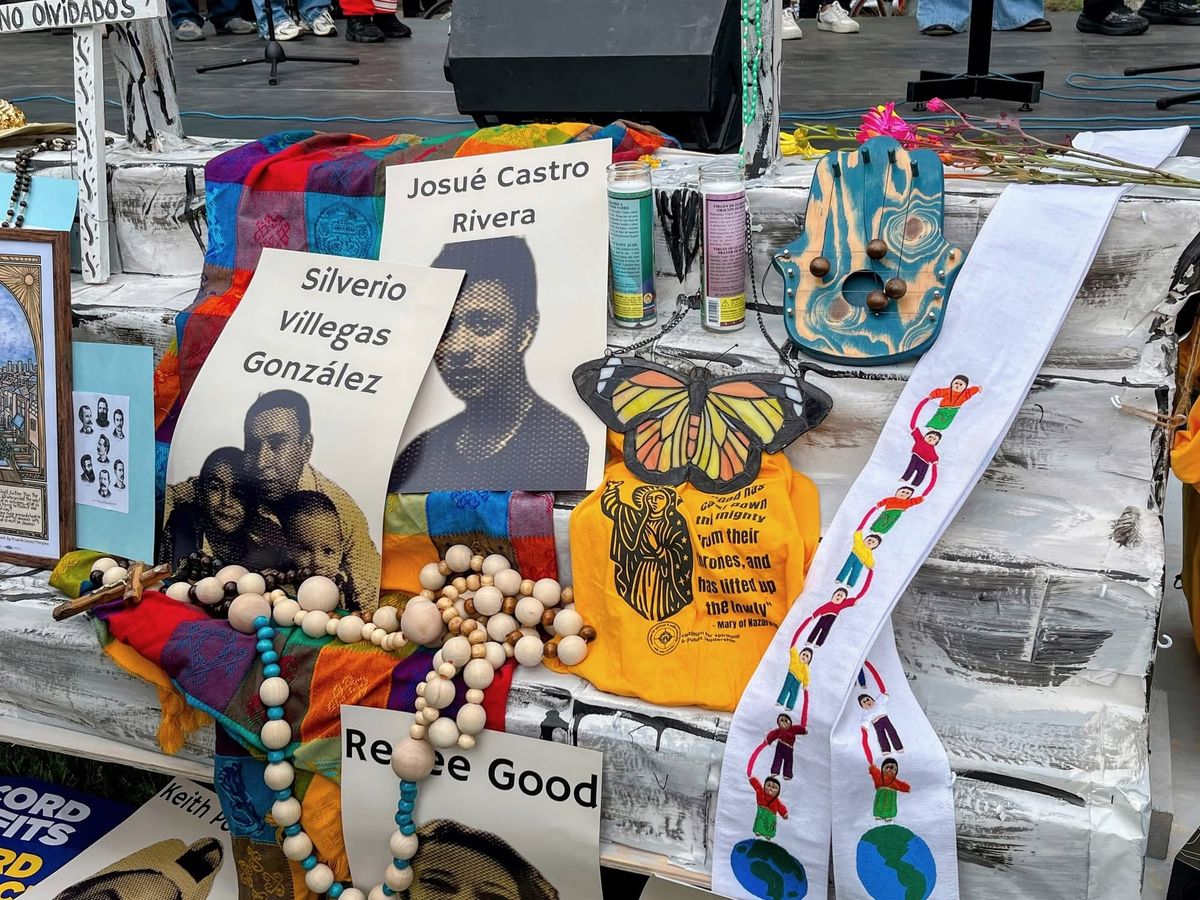

The violence and scale of the Trump administration’s attacks on immigrants and the communities they live in can be disorienting. In recent months, the terrain has shifted from roving spectacles of violence in blue cities to arrests increasingly embedded in the everyday harms of policing. Meanwhile, activists and community members have forced the administration to retreat from one of its most horrifying aspirations to date, a network of Amazon-style detention warehouses, some of which could have held as many as 10,000 people and accelerated deportations on an industrial scale.
How can we keep our bearings in these times—celebrating our wins and our solidarity while also keeping up with the shifting tactics of the deportation machine? I recently spoke with Silky Shah, executive director of Detention Watch Network and author of Unbuild Walls. Silky’s insights are invaluable for understanding how the machinery of enforcement is changing, where communities still have leverage and what it will take to sustain resistance over time.
This interview has been lightly edited for length and clarity.
Kelly Hayes: We've seen a lot of headlines and outrage about the recent killings committed by ICE agents, including the deaths of Lorenzo Salgado Araujo and Johan Sebastián Durán Guerrero. The outrage and attention to those shootings are obviously called for. But the detention system itself is also killing people, with the death toll at its highest level in more than a decade. People are being held for longer periods in torturous conditions that can function as a form of coercion, pushing people to abandon their cases and accept deportation. I’ve also heard from undocumented people who are choosing to leave the country rather than risk prolonged imprisonment in potentially deadly conditions. What do we need to understand about detention itself as a site of organized violence—both the machinery producing these deaths and the way the threat of detention is being used to force people out of the country?
Silky Shah: It’s important to understand that detention is ultimately a site of social control. The way the Trump administration is exacerbating conditions in detention is laying bare what the system does. As our friend Mariame Kaba says, this is a death-making institution. As of July 23, there have been 53 deaths in ICE custody since Trump came back into office. That is a scale we’ve never seen before.
Detention has also always been a place where conditions are so bad that people become ready to sign away their rights and say, “It’s fine. I’m ready to leave.” That is all being exacerbated now. The conditions are so much worse.
One of the things I’ve been struggling with is that, for many years, efforts to improve conditions have not actually made these facilities better. I think that is true of both the prison system and the detention system. There is so much emphasis on improving conditions when the answer is actually to release people. The best way for people to have good physical and mental health is not to be in these institutions.
But in this context, oversight mechanisms have been completely stripped away, and there is also a psychological mandate from this government to dehumanize people in detention even further. You are seeing the scale of violence go up and up and up. That is why more people are dying in detention and more people are dying by suicide. It is also why people are that much more afraid of being detained. They might not get the medical care they need. They might not get food or clean clothing. They might be sleeping on floors. The conditions are horrifying.
There is also the added threat of potentially being deported to a so-called “third country.” People might be thinking about the story of Tuan Phan, who was imprisoned for many years here in Washington State. When he was about to be released, instead of being deported to Vietnam, where he was from, he was sent to Djibouti. He was held for roughly six weeks in a shipping container at a US military base in Djibouti and then spent nearly a year detained in South Sudan, essentially like a prisoner of war. He is finally back in Vietnam now, but imagine what it means for people not to know where they might end up.
There is no question that detention is an institution of social control. This administration is exacerbating the conditions and heightening everything detention has always done: causing premature death, pushing people to sign away their rights and potentially compelling people to leave on their own.
I don’t think there is any going back to a system that supposedly does this better. Yes, these conditions may not have been as extreme before, but all of this was already happening. It is now happening on a much greater scale.
Kelly Hayes: That intensification of detention is unfolding alongside a shift in how ICE is operating in communities. The large-scale, roving-gang-style attacks on urban neighborhoods were enraging, but the concentration of those operations did create clearer opportunities for intervention than some of the less visible, less spectacle-driven tactics ICE is deploying now. Yet ICE agents are arresting more people than ever. What do organizers need to understand about this tactical shift, and how does it change the possibilities for intervention?
Silky Shah: I think the best way to understand the difference between how Democrats and Republicans have operated is that the right really likes the spectacle of immigration enforcement—the arrests and deportations. We’ve seen this over time.
During the Bush era, after 9/11, there were massive worksite raids. They were incredibly disruptive, especially in small communities. You would have 700 people who worked at a factory detained at once, and children would end up in foster care. It was really, really disruptive, and those raids received a lot of attention.
The Obama administration moved away from that approach and tied immigration enforcement more closely to the criminal legal system. That is where we saw more deportations taking place, with people being put into the pipeline through county jails in their own communities.
Under the first Trump administration, you again saw a return to worksite raids and these large operations. The Biden administration then retreated from that approach. During the Biden era, much of the spectacle became focused on the border.
Now, over the last year and a half, especially in places like Los Angeles, Chicago and Minneapolis, we have seen intense spectacles of violence. In January, Operation Metro Surge in Minneapolis captured the nation’s attention because of the extreme violence, including the killings of US citizens. There were roughly 3,000 federal immigration-enforcement agents there, which was a huge number, and it was incredible to see the solidarity and resistance.
At the same time, the number of arrests in Minnesota during that operation was less than half the number made through the Miami field office over the same period.
Florida is really ground zero for how much immigration enforcement is changing and expanding. In Florida, Tennessee, Louisiana and Texas, state troopers and local police departments have entered into 287(g) agreements, which give local law enforcement authority and funding to target people for immigration enforcement.
There is so much collaboration happening between ICE and local law enforcement in those places that the scale of enforcement is much greater, without the same level of spectacle. I think that is also what we saw a lot of during the Obama years. Those years were really the last time we saw a high level of interior deportations. Again, though, everything is happening at a greater scale now.
After Operation Metro Surge began winding down, Tom Homan, who has been referred to as the border czar and was a career ICE official, held a press conference in which he emphasized that they were going to work much more with local police. That was going to be their strategy.
ICE’s workforce has also doubled in the last year. So you have a combination of more and more ICE agents and more collaboration between police and ICE, including in places like Houston, where Lorenzo Salgado Araujo was just murdered. There is much more targeting happening in those places.
I think it is going to be a huge challenge. Given the scale of violence they are pursuing, they are going to find more and more ways to target people. They are also doing everything they can to strip people of legal status. With the administration moving to terminate Temporary Protected Status for multiple nationalities, and the Supreme Court allowing some of those terminations to proceed, more than a million people could become vulnerable, and the government already has data on those individuals.
That is what is so scary about this moment. It is still critical for people to know their rights. And I think that in places like Minneapolis—and I’m from Houston—seeing the way communities have come together has been phenomenal. This is about community organizing. It is about supporting people, making sure their needs are met, and maintaining ICE watch programs, phone trees and all the other things communities can do. All of that is much more critical now.
The other issue is detention. Having more detention capacity means they can arrest more people, detain more people and deport more people. Stopping that expansion is also a really critical aspect of this work.
I think those are the main tactics at this moment: trying to stop the expansion of detention and getting communities and elected officials to do everything they can to stop sharing data with ICE, so that ICE does not have the information or the ability to target more people.
Kelly Hayes: As the government expands its capacity to target and detain people, critics of the administration have increasingly emphasized the gap between the government’s rhetoric and who is actually being swept up. People with no criminal history remain the largest group in ICE detention, even as the administration continues to peddle a narrative centered on criminality. Is there a narrative tension here between exposing their lies and avoiding the implication that some people deserve this violence?
Silky Shah: Yes, absolutely. There’s a huge narrative tension. It’s been really challenging.
I started working at Detention Watch Network in 2009. I had been doing this work before, but Obama had just come into office. Soon after that, the Black Lives Matter movement was on the rise. The work we were doing to combat deportations and the growth of detention was riding the wave of a broader racial reckoning and questioning of the criminal legal system, the prison industrial complex, policing and incarceration generally. It allowed us to make the case for immigrants caught up in the system, including people who had contact with the criminal legal system.
All those years of relying on the good immigrant versus bad immigrant narrative have culminated in this moment, because you are constantly making the case that some people are deserving and some people are undeserving.
The good immigrant versus bad immigrant framework really leans into criminalization narratives. There is also the old immigrant versus new immigrant framework, which gets into the psychology of bordering. If you keep doing that, you get to a place where everybody is considered a bad immigrant. That is what this administration is saying. It is, of course, coming from a white supremacist ideology, but that has been the strategy.
I think that is what has been so harmful about the Democrats and a liberal framework that accepts some detention and some deportation. It accepts these really violent institutions and the expansion of those institutions over time, which has really fueled these far-right narratives.
The detention system is so large right now. It is really tough, because it is understandable that people are grasping onto whatever they can to make the case against more people being detained and deported. Our society has really pushed the idea that immigration is about public safety and national security, and those associations are deeply embedded. I think it is our responsibility to challenge that constantly.
I understand why people make those arguments. But if we stay within the framework of saying, “These individuals are innocent,” then, if we get to the other side of this, we will most likely return to the status quo. That means most people in detention will be people who have had contact with the criminal legal system and people who have recently arrived. That is what it was under Biden.
The other thing to name is that the number of people being transferred from prisons and jails into immigration detention has doubled under Trump. So it is not only people who have had no contact with the criminal legal system. Yes, that group is larger than we have ever really seen in ICE’s history. But people who have had contact with the criminal legal system remain more likely to be put into detention. I think it is important that we reckon with that.
It also goes back to understanding that the US has the world’s largest prison system, and that the growth of mass incarceration was about warehousing more and more people who were considered undesirable or without worth. The laws changed to expand that scope. We are seeing the same thing with the detention system. It is not happening in a vacuum.
It is much harder in the context of the post-BLM era. But in this moment, when people are much clearer about the problems with detention and deportation, what do we need to do to make sure that a critique and understanding of the prison industrial complex remain central to how we talk about this? Because this is the prison industrial complex. That is exactly what it is.
At the same time, I have said this for so long: Detention Watch Network and the work I have done have been trying to help people better understand how the growth of the prison industrial complex changed the deportation machine and immigration enforcement. Now we are seeing shifts in the Bureau of Prisons and in how policing is becoming more about immigration. How is the obsession with mass deportation changing prisons and policing? We have to understand it all together.
Kelly Hayes: That really gets at a tension I’ve encountered as someone who is often in the role of storyteller. People are pulled into these situations, and they and their families want you to tell the truth of their lives. Sometimes that is a story about how they have never harmed anyone and have always complied with whatever the law demanded of them.
People deserve the opportunity to speak to the truth of their lives and experiences, and they are right when they say the administration is lying. At the same time, we have to be able to hold the truths you’re talking about. We need to understand that the fact that people who have previously had no contact with the criminal legal system are getting swept up is an inevitable consequence of allowing these broadening categories of disposability to exist. It becomes easier to dispose of anyone by ensnaring them in a carceral net.
People often don’t want to reckon with the fact that criminal arrests are so often the product of identity or the arbitrary whims of police, coupled with norms about whom they are allowed to abuse, detain or disappear into the system. As you said, people wind up in prisons because of designations of worth. The law is not a moral instrument. I agree that it will set us back horribly if we manage to get past the Trump and MAGA moment but haven’t addressed these underlying realities.
We can’t set ourselves up to experience this all over again, or to experience it on quieter, more orderly terms. When we empower this thing with our imaginations by participating in the kind of social forgetting that criminalization perpetuates, we create the machinery that fascists need—the machinery they are using right now to perpetrate their violence.
Silky Shah: I remember so many members of Congress speaking about what was happening during the hunger strikes at Delaney Hall. The whole narrative was, “These people are innocent. They don’t deserve this.” I don’t think that is helpful. Nobody deserves this. The conditions in Delaney Hall are not fit for anybody.
When you are making these broader arguments about the system, that is one thing. But whenever you are telling someone’s individual story, the question is: How do you do that in a way that doesn’t end up doing a disservice to other people? I think there are ways to do that.
Kelly Hayes: Delaney Hall is a great example, and I’m glad you brought it up, because it’s one I struggled with. While it’s not hard for me to blow off the framing of an elected official, the people inside Delaney Hall who were writing letters, telling their stories and pleading with people on the outside to uplift their words were continuously emphasizing, “We’re not criminals.” Again and again, those words appeared.
It’s so sad, because you understand why. They understand how quickly people in the US disregard any concern for, or even memory of, people who are incarcerated. What people endure once they are in prison is completely written off in the popular imagination. And these people in detention, who are being sexually assaulted, denied medical care, subjected to forced labor, brutalized and so much more, are begging not to be memory-holed in that way. They are pleading to be seen and understood as deserving of care, protection and mercy.
As a storyteller, I’m not going to filter out their refrain. That feels wrong. But I am going to name how sad it is that they would feel compelled to say this, given that what they are experiencing should not happen to anyone—that there is literally nothing they or anyone else could have done to warrant this abuse. I think we need to be able to hold all of that, and it’s hard. It really is.
Silky Shah: I think it’s such a huge challenge. It also points to why political education is so critical, even though it won’t reach everybody. How do we make sure we aren’t just staying at a surface-level understanding of what is happening here? Deeper political education is the only way we begin to get out of this. It’s very tough.
I also think we can stay true to our values and our understanding of this system without having to fall into that frame in the work we do.
Kelly Hayes: That kind of political education also shapes how people understand where they have leverage and what forms of intervention are possible. For example, organizers have managed to delay or stop some proposed detention sites.
You’ve observed that the government's warehouse strategy was partly an effort to eliminate the pressure points organizers have had with facilities that are more deeply entangled with local governments, economies and communities. Has the federal government backed down from that strategy, or is it adapting? And what have these campaigns taught us, not only about where communities have leverage, but about what people have to build together in order to exercise it?
Silky Shah: Yeah, I think the warehouse strategy was definitely an attempt to circumvent the ways we as a movement have tried to curb detention expansion. The initial re-engineering project was aimed at consolidating much of a system that currently includes more than 200 detention sites into 30 to 40 facilities. There are many different types of detention, but for the purposes of this discussion, I’m talking about facilities where people are held for more than 72 hours—often for weeks, months or sometimes even years.
The plan included some very, very large facilities, including unprecedented sites with 10,000 beds, alongside a series of private prisons. That would give them greater control over the system.
As you were saying, many of our strategies to curb detention expansion, or even shut down facilities, have focused over the last decade on organizing locally: pressuring county councils or county commissioners, passing state legislation, stopping facilities through zoning restrictions and saying, “No, we don’t want these facilities in our communities.”
That has been successful, and their hope was to get around it. So, yes, I think what has happened with the warehouse plan has actually been a huge victory. They have retreated. Just last they officially abandoned plans to use the two sites they purchased in Pennsylvania as detention centers and are expected to sell them or transfer them to other federal agencies. Across the country, we are seeing shifts around these warehouse sites, which is really exciting.
There are still places, including West Texas, where they are moving ahead. It might look different and might not happen at the same scale, but they are still moving forward with some of what they were planning, and we are still doing a lot to fight that.
Ultimately, there was a broad organizing infrastructure that came together, including infrastructure built in real time in places like Social Circle, Georgia; Surprise, Arizona; and Hutchins, Texas, where communities came together and said, “We don’t want this in our community.” In some places, people had been organizing for a very long time. In Pennsylvania, the Shutdown Detention Coalition, which has focused heavily on the Moshannon facility, was fighting back against the warehouses.
In Surprise, Arizona, people were so frustrated with their elected leaders and the choices they were making that they were pushing to unincorporate the town. Some narratives argue that the government is retreating because it has been blocked by litigation. But the important thing to understand is that much of that litigation only happened because of organizing and community outrage in Maryland and Arizona.
People fought back and said, “No, we don’t want this in our communities,” and that pushed state governments to intervene. All of that has been incredible to witness. It has been incredible to see people rise up—people who have been doing this work for years, people who are new to it and ordinary people fighting back and recognizing that they can do something to stop the scale of deportations we are seeing.
Another thing they planned to do through the re-engineering project, and have already started doing in California, is purchase private prison sites. Instead of private prison companies owning the sites, the federal government will own them. Part of what they are trying to do is evade state law.
For example, because of litigation in Washington State, people participating in the so-called “voluntary work program” in these facilities must be paid Washington’s minimum wage instead of the dollar a day they are usually paid at private facilities. This is how the detention system works: Often, detained people do the work of preparing food, doing laundry and cleaning the facility, and they are paid $1 a day.
There have been many interventions around this, with states saying, “No, you can’t do that.” But if DHS owns the site, even if a private prison company still operates it, they might be able to evade those laws and continue doing whatever they want. They might not have to pay property taxes. They might be able to get around some zoning restrictions.
All of that is still happening. They have started doing this in California, and they are looking at other places where they can buy private prisons. The larger point is that whenever we win a campaign or get closer to curbing the detention system, they find ways to circumvent that victory. That is what happens. This is what we negotiate in movements all the time. Just because we win something and then a facility opens again, or something else happens, does not take away from that win.
We need to hold on to how significant it is, for instance, that Illinois does not have long-term detention. That means they can only target and arrest so many people because they do not have that capacity.
It has been remarkable to see what communities have done, and these wins are important. But the government is still expanding detention everywhere. They are planning new private prisons in Minnesota. On SAM.gov, where the government posts requests for proposals, they recently put out a request for nearly a dozen detention expansion projects including new facilities and add-ons to existing detention centers. They are trying to expand everywhere.
Even if public outrage and organizing have stopped them from carrying out this particular plan, they still have billions of dollars. The detention re-engineering plan alone was budgeted at $38.3 billion through the end of 2026, and they are still trying to expand it.
There are still many ways to intervene. Places like New York and New Mexico have passed laws to stop detention. State law can still stop detention expansion, and there are still ways to intervene at the local level.
That is what has been so interesting about this moment. People are innovating strategies and thinking about different ways to respond whenever the government finds a way to circumvent an earlier victory. That is what we always have to do.
Kelly Hayes: I think it’s so important, as you say, to recognize the significance of this victory. The federal government wanted Amazon-style warehouses where it could brutally process human beings out of the country. It had a vision for an industrialized kind of ethnic cleansing in facilities that, as you say, it wanted to place beyond the reach of so many organizing tactics—tactics that John Washington documents in his book How to Close a Camp.
That vision could be coming to fruition right now, and it isn’t, because people have fought with every tool at their disposal. That picture includes litigation, but as you say, without so much resistance, we wouldn’t have seen all of those legal maneuvers, or the actions of officials who may not care about detention but do care about their constituents being angry. The administration was also staring at a country where so many people were incensed by the warehouse plan and where communities were gearing up to fight wherever it tried to implement it.
I really want to praise the Detention Watch Network and others who helped people prepare for those fights. I especially appreciated the toolkit Detention Watch Network shared, “DHS Expansion of Immigration Detention into Warehouses.” I shared that resource on Movement Memos, and I know it meant a lot to people to have a practical resource they could turn to as they strategized around this issue.
That effort to evade state and local constraints also raises a broader question about the relationship between the federal government and private prison companies.
GEO Group is not simply profiting from detention expansion. It is involved across the enforcement system, from detention and transportation to electronic monitoring. Former GEO figures, of course, now occupy senior roles in the administration. How should we understand the relationship between the company and the state at this point? And where is that relationship vulnerable to disruption?
Silky Shah: So, the two major private prison companies are CoreCivic and GEO Group, both of which changed their names to “improve their branding.” CoreCivic started out as Corrections Corporation of America, and GEO Group was Wackenhut Corrections.
The immigration detention system came about at a time when neoliberalism was really on the rise. GEO Group was founded in 1984, and its first prison facility was the Aurora Detention Center, which is still operating outside Denver, Colorado. Immigration detention has always been core to what GEO Group does.
Over time, detention under INS, and eventually ICE, was constantly expanding. Private prison companies always saw that expansion as an opportunity to grow their bottom line. That is why private prisons have not only expanded under Republican presidents. They grew significantly under Obama and also under Biden, at least with respect to ICE detention.
Now, as you were saying, the acting director of ICE is David Venturella. There is a revolving door. Venturella was a career immigration enforcement official who went to work for GEO Group and then returned to government. That is true of many people who have worked at GEO Group. The state and capital are working together.
During the Obama administration, the government was trying to make detention facilities nicer, and the private prison companies said, “We can do that.” Compared with all the disparate county jails across the country, they were better equipped to meet what the government was asking for. ICE began using more private prisons during that period.
Similarly, there was a major push for a family case management program, which many NGOs applied to operate. At the last minute, GEO Group created an entirely new entity called GEO Care specifically for that contract and was awarded it. This happened during the Obama years. It is important to understand that GEO Group is essentially a detention conglomerate. The company adapts to what the government wants.
There is sometimes tension around this for people who organize around state or federal prison systems, where most facilities are public. All incarceration is about political economy. It is not only about private prisons. Our leverage does not necessarily lie in focusing on the fact that these facilities are privately operated. It lies in focusing on the fact that detention itself is the problem. The best way to get rid of private prisons is to get rid of detention. There is no question that is the most important way to do it.
At the same time, in this Trump context, we are seeing something more heightened and adaptive. ICE has largely been built around a private prison model, but we are also seeing crony capitalism and even closer collaboration between state and capital. It is important to understand and call out those interconnections while also indicting the whole system.
There have been many divestment campaigns and efforts to push banks to divest from GEO Group. I think those campaigns are really important for raising awareness and helping people understand what is happening. I also completely understand people saying, “I don’t want my investments going into these really harmful systems.”
But if we meaningfully want to get rid of private prisons—and get rid of GEO Group and all that it does—the important thing is to indict the entire system and all the ways it adapts. GEO Group has taken over electronic monitoring, operating case management programs, providing transportation and running private prisons. We need that larger picture in order to understand the role GEO Group plays.
Kelly Hayes: I appreciate your point about crony capitalism because, while we definitely need to indict the system as a whole, I also think the openly transactional relationship between this administration and its corporate beneficiaries is important to name. Venturella moved from a paid GEO consultancy into ICE after a gap of less than two weeks. He then received a waiver allowing him to work immediately on matters involving GEO, rather than observing the already-flimsy one-year waiting period. That kind of naked corruption energizes the forces profiting from this administration while empowering particular vehicles and mechanisms through which its violence is carried out.
Taking all of this together, where should people who are outraged be directing their energy right now? What do communities need to build so that people facing detention, deportation or the threat of either are not left isolated?
Silky Shah: I think this is a time to build on organizing on the ground and sustain it over time. What does that look like? How do we sustain organizing while continuing to bring people in, so this isn’t just a fleeting moment?
I’ve been fighting the immigration detention system for over 20 years. It’s wild to see how ready people are to say “abolish ICE,” to see businesses put up signs saying, “ICE is not welcome here,” and to see local counties pass ordinances against ICE and new detention facilities. All of that is so exciting, and I don’t want it to be fleeting. It’s so important that we sustain it.
Detention Watch Network just launched the End the ICE Age campaign. It’s really important to push to get ICE out of our communities, but as we’ve been discussing, ICE is more than ICE agents. It’s the detention centers, all the funding coming from Congress, the culture of ICE and how it pervades the military, and, of course, the collaborations between ICE and police.
When I talk to people in Florida and Texas, a lot of the time it’s not as much about ICE itself as it is about local police, state troopers and all these different entities. Ending the ICE Age is about understanding the role ICE plays in your community.
How are you protecting people in your community? How are you building the capacity to support them? What has been amazing to see is both the on-the-ground support and, once people are detained, the skyrocketing number of habeas petitions seeking their release. People are educating themselves about how to do that. Habeas projects have emerged in different communities, and people are educating themselves about the relationship between ICE and their local counties.
In many states, including Tennessee, Florida and Texas, lawmakers are constantly trying to pass harsh anti-immigrant legislation that further criminalizes immigrants. People need to work at the state level to make sure things don’t get worse—not only through federal policy, but through state policy as well.
A big part of Ending the ICE Age is also refusing to accept that the roughly $170 billion Congress approved for immigration enforcement last year—including $75 billion for ICE over four years—has to be spent on all of this. In January, it was amazing to see more than a thousand organizations sign on to say, “No, we can actually claw back and repeal some of this funding.” Senator Sanders introduced an amendment to repeal that $75 billion increase and redirect the money to Medicaid, and 49 senators voted for it. Depending on what happens in November, I think there is a real possibility that we could claw back some of this money.
There are so many levels at which people can do this work: in your neighborhood, with your county, at the state level or by reaching out to your member of Congress. Representative Delia Ramirez introduced the Melt ICE Act, which would end DHS funding for immigration detention and electronic monitoring and redirect that funding. How do we start building power around that?
It’s really great to see these wins, including the victories against the warehouses, but we know they are going to keep trying to expand detention. We still have, at minimum, another two and a half years of this scale of violence. What are we doing to sustain our momentum over time? How are we making sure we are prepared for the next opening?
Get involved in your local community and check out End the ICE Age. Detention Watch Network also has many resources from our Communities Not Cages campaign, which did a lot to support organizing against the warehouses.
I constantly oscillate between being devastated by the deaths and scared about where things are going, especially given how high the number of arrests has risen, but also it’s been inspiring seeing people rise up in Houston, seeing the incredible work that happened in small towns around the warehouses, and seeing how strongly people are holding onto and normalizing the idea that ICE does not need to exist. I think there is a lot of opportunity. We need to keep this going and make sure we sustain it over time.
Kelly Hayes: Thank you so much, Silky. I really appreciate the chance to hear your insights. These are disorienting times, and it really helps to check in with people you trust. Thank you for helping us get a sense of where we are and think through how we can do the most good under shifting conditions. I appreciate you.
Silky Shah: Right back at you, Kelly. I love talking to you. It’s always lovely to hear your thoughts as well.
Organizing My Thoughts is a reader-supported newsletter. I’ve been losing a significant number of paid subscriptions lately as more people face financial strain. These are hard times, and I hope we all see better days soon. Paid subscriptions are what allow me to keep this work accessible to everyone, because I won’t put it behind a paywall. If you’re in a position to pitch in and support the creation of these letters, interviews, essays, reports, and lists, I would be grateful for your support.