They Called It Conspiracy: Joselyn Walsh on Federal Charges and the Criminalization of Protest
"A conspiracy charge is deeply isolating, which I think is probably part of the point from the government’s perspective," says Joselyn Walsh.


A month after a September 2025 protest outside the Broadview ICE facility in suburban Chicago, six people were federally indicted on conspiracy and interference charges, in a case many organizers saw as an effort to recast protest and collective action as criminal conspiracy. The prosecution’s theory—including the idea that a group of protesters could form a “spontaneous” conspiracy in a matter of seconds—made the Broadview 6 case a high-profile test of how far the government could stretch conspiracy law in order to criminalize dissent. This week, prosecutors abruptly dropped the charges against two defendants, Joselyn Walsh and Cat Sharp, “in the interests of justice.”
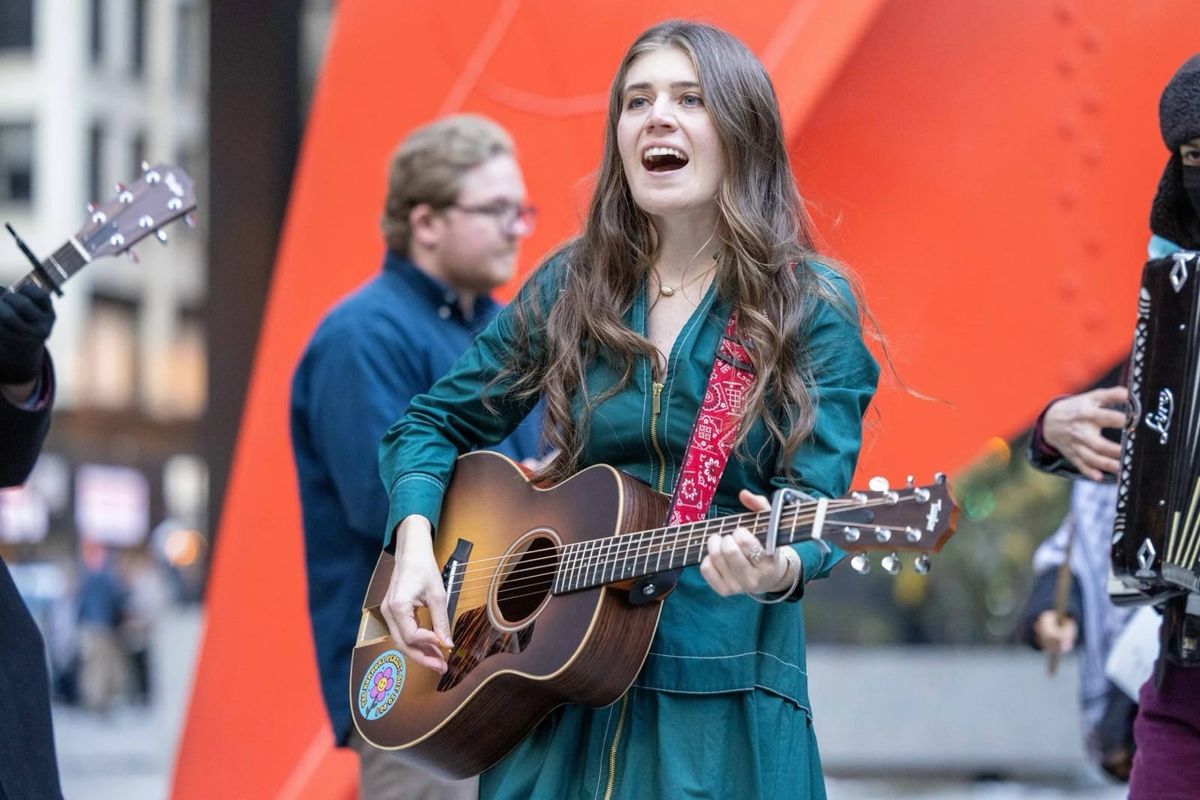
Some people know Walsh as a performer with Songs for Liberation, whose songs carried through tear gas outside the Broadview facility during Operation Midway Blitz. Others may remember the hole a foam baton round tore through her guitar at one of those protests. To me, Joselyn is a friend and co-struggler, and someone I have been deeply worried about throughout this ordeal. Amid our shared relief over the charges being dropped, she made time to talk with me about the emotional and political toll of the case, the importance of documentation, and the sustaining force of music, friendship, and mutual care.
This interview has been lightly edited for clarity.
Kelly Hayes: You’ve lived under the cloud of a federal conspiracy indictment for months. Can you describe the moment you found out the charges were dropped? What was the first thing you did?
Joselyn Walsh: The moment I found out the charges were dropped was a real mix of emotions. I had friends and family at my apartment when I got the call from my lawyers, and we all hugged and, predictably, started singing and dancing to music. I felt relief that the charges were dropped, and frustration that their abrupt dismissal was such a clear admission that they never should have been brought in the first place.
This has been a scary, chaotic, and uncertain time, but over the last couple of months, I had grown so confident that we would win that I stopped feeling scared. What I felt instead was determination and energy to use this moment to put the government on blast and expose its violence and hypocrisy. My supporters and I were looking forward to using the attention around the trial to keep speaking about the violence of ICE, the need to organize together, and the urgency of abolishing ICE.
In a way, having the charges quietly dismissed after the worst of the stress had passed, but just before we could expose their ridiculousness at trial, feels a bit like being silenced all over again.
KH: In court, the prosecution described this as a "spontaneous" conspiracy—essentially arguing that a group of people could form a criminal agreement in a matter of seconds during a protest. How did it feel to have your presence in a crowd interpreted by the government as a formal criminal conspiracy?
JW: That felt frustratingly ludicrous, and like such a dangerous precedent to set. When they have all the power, all the weapons, and the force of the U.S. military behind their violent and unlawful operations, one of the only things we have is people power in response.
I want to reiterate that I had never met or spoken to the people I was charged with conspiring with. But I never go to a protest alone. I go with friends and musical buddies I can play songs of peace and resistance with. I know that by being together and looking out for each other, we help keep one another safe.
I’m deeply worried about the precedent this sets—not only treating protest in general as a “conspiracy,” but escalating that logic even further with the idea of “spontaneous” conspiracy. It feels like a massive overreach and a denial of our freedom. At the same time, I think the dismissal of these charges shows that we are winning, and that no one is really buying that kind of ridiculous bullshit.
KH: Much of the defense’s argument centered on bodycam and witness footage that contradicted the initial claims made by federal agents. What has this experience taught you about the importance of independent documentation and "bearing witness" at actions?
JW: It is so important for us to bear witness and share information and stories about what is actually happening on the ground. When charges are brought, they often have a chilling effect on how we talk to each other and what we feel safe discussing. While we should all strive to be thoughtful and practice good security around protest-related conversations, sharing information about what is really happening helps us keep each other safe and push back against false media narratives.
For example, on the day Kristi Noem visited the Broadview facility in October 2025, there was a moment when Illinois State Police suddenly pushed into the crowd, threw people to the ground, and began making arrests—on the very grass they had just instructed us to stand on. We quickly realized they had created that chaotic moment to use as a photo op for Noem and to paint us as “violent protestors.”
It is incredibly frustrating to see media narratives cast doubt on people’s traumatic experiences, when we know the agencies of this administration constantly lie to the press. Bearing witness and sharing our stories with each other is essential if we want to fight back against these damaging, false narratives.
KH: Cat Sharp mentioned that the financial and emotional toll of this case forced her to change her own professional plans. What has been the most significant "hidden cost" of this legal battle for you over the last few months?
JW: The energy, time, and stress of this case have carried some serious hidden costs. It has affected my ability to communicate freely with friends and fellow organizers, and it has limited my capacity to contribute to projects I care about. There has also been the stress of missed work, meetings with lawyers, and the constant uncertainty surrounding everything, especially when the charges were first brought.
A conspiracy charge is deeply isolating, which I think is probably part of the point from the government’s perspective. As we’ve said so many times, I didn’t know any of the other defendants before this happened, and the conspiracy charge made all of us hesitant to meet or get to know one another afterward, even though people in those situations often come together to support each other.
It was also isolating to live with so much uncertainty about how I could safely relate to musicians and friends I had previously protested with—people who might feel they needed to avoid certain conversations with me, or keep their distance altogether, after I had been federally charged.
KH: Navigating a federal case can be incredibly isolating. Beyond the public rallies, how did the more quiet, day-to-day support from fellow organizers and friends help you manage the uncertainty of these past few months?
JW: I am so grateful to the friends who helped me figure out how to respond and how to keep organizing during this time. It was hard to know what to do, what I was able to do, what was needed, and what would actually be good for me. I’m grateful to the people who helped me ask and answer those questions, who came over and cooked dinner for me, and who helped me think through how to stay in movement while I was feeling both deeply isolated and in need of rest and care.
I’m also grateful to the people who helped me think about how to use my voice from a different positionality than some of my co-defendants, including those who were political candidates. And I’m grateful for friends near and far who reached out just to say, “Thinking about you.” It can be really hard to ask for help, especially when you’re not sure what you need and you’re in the middle of something overwhelming. At first, I think my instinct was to say, my legal fees are covered through public defense, so I don’t need anything. We’ve put together a Fundrazr now to help cover some of the more hidden financial costs, and I feel relieved to be asking for help.
I really appreciate the friends who pushed me to be honest with myself about how much I was struggling under the weight of all of this, who stayed in conversation with me, and who reminded me that “we keep us safe” means supporting each other when we’re targeted by law enforcement for standing up for what we believe in. They helped me understand that it was okay to ask for what I needed.
KH: During your arraignment, you played music with the same guitar that was hit by a rubber bullet at the protest. Now that the charges are gone, do you feel that your music has a different role to play in how you process or share this story?
JW: I think this experience has deepened my appreciation for the role of music in protest, and it has made me feel bolder about putting my music out into the world. Writing songs about this experience has been cathartic, and I’m looking forward to continuing to share them with my community and beyond. I want to keep telling this story and contribute to the beautiful tapestry of musical and artistic resistance so many people are cultivating right now.
Next week, I’ll be back in the studio recording a new song about all of this with my partner and some of our closest collaborators. There will be more music this year from my band, weird rabbit?, as well as from my solo project, Hayward.
KH: While your charges were dropped "in the interests of justice," four others are still heading toward a May trial. How can the community most effectively support them now that the government has acknowledged some of the evidence in this case was worth re-evaluating?
JW: I think our charges being dropped bodes well for the remaining defendants. I’m frustrated that the charges weren’t dropped for everyone. Without any coordination among us, we all had the same instinct that day: to use our voices and stand up for what we believed in when we went out to protest. I am confident that a jury will see how ridiculous the remaining charges are and find the other defendants not guilty.
People can support them by sharing their story, attending the trial, showing up outside the courthouse on May 26, and continuing to center and fight what we were all protesting in the first place: the violence of ICE in our communities has got to go.
KH: I know that our relief over the charges against you and Cat being dropped is tempered by the fact that some of your co-defendants are still facing charges, and by the devastating news out of Texas, where multiple Prairieland defendants have now been convicted. Do you want to say something about what that verdict means to you, and what you think people should understand about that case?
The verdict in that case is devastating, and it has complicated the relief I feel over the charges against me and Cat being dropped. I worry that dismissing our charges “in the interests of justice” helps create a narrative of prosecutorial reasonableness even as this government continues criminalizing protest, here in Chicago and around the country. I am not trying to collapse the differences between the two cases, but I do see one important commonality: this government is fundamentally untrustworthy. There was no reason to believe the charges against us were valid, and I believe that is true in Texas as well.
In case after case, we have seen the government’s lies fall apart. We have seen prosecutors and law enforcement stitch basic acts of political expression into claims of conspiracy. We have to start from a place of skepticism toward law enforcement narratives about dissenters, and toward the stories they tell to justify their violence more broadly. We have to reject the “good protester / bad protester” narratives that state violence so often depends on. What is happening in Texas is part of a broader effort to criminalize dissent, exaggerate threat, and construct expansive theories of guilt out of protest, association, and political expression. We cannot begin from trust in the government’s story. We have to begin from solidarity with the people they are trying to disappear.
KH: Is there anything else you would like to share with or ask of our readers?
JW: Thank you for listening to my story. I hope that knowing how all of this played out emboldens more people to protest for what they believe in and to work toward building the world they want to see. We are winning, and we will keep winning the more we work together and support each other.
We’re sharing more of my story, and keeping a running record of other related ICE protest cases in Chicago and around the country, at defenddissentatbroadview.com.
On a personal level, I’ve been organizing around food sovereignty in Chicago for several years, and I’m part of the group working to launch Nourish Community Co-op on the Southwest Side. If you want to help us advance food justice in Chicago, support my work on new music this year, and help us keep telling stories of resistance, please check out the fundraiser.
Organizing My Thoughts is a reader-supported newsletter. If you appreciate my work, please consider becoming a free or paid subscriber today. There are no paywalls for the essays, reports, interviews, and excerpts published here. However, I could not do this work without the support of readers like you, so if you are able to contribute financially, I would greatly appreciate your help.